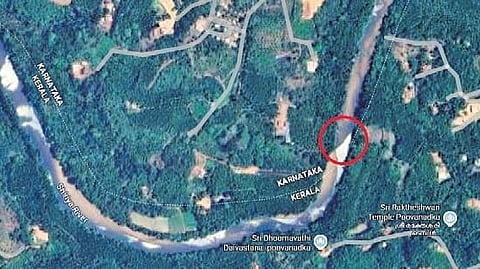

MANGALURU: For decades, two neighbouring villages separated by the Shiriya river have lived with a paradox of proximity and distance. As the crow flies, Manila and Perla are barely 7 km apart. But by road, the journey stretches to nearly 27 km, forcing residents to take a long, winding route through multiple villages to stay connected. That disconnect may soon be history.
In a move expected to transform local mobility and revive deep-rooted social ties, the Karnataka government has approved Rs 20 crore for the construction of a bridge across the Shiriya River, which forms the natural boundary between Karnataka and Kerala. The proposed structure, 80 metres long and 10 metres wide, will link Kamajalu in Manila village in Dakshina Kannada with Poovanadka in Perla of Kasaragod, drastically cutting travel time and distance.
For residents on both sides, the bridge is more than just an infrastructure project-it is an emotional lifeline.
“This has been a long-pending demand,” said GK Bhat, an elderly farmer from Manila. “Our villages share strong matrimonial and cultural ties. Priests from Poovanadka regularly come here for rituals, and many women married into families here have their parental homes in Perla. Yet, visiting each other has always been difficult due to the long route. This bridge will finally bring us closer.”
Currently, commuters must navigate a ‘U’-shaped road passing through Peruvai, Kuddupadavu, Adyanadka, and Saradka to travel between the two villages. The proposed bridge is expected to reduce the distance to just 6-7 kilometres, offering a direct and efficient connection.
Beyond social ties, the project is also expected to provide a significant economic boost to the region. Farmers, particularly rubber growers in and around Manila, stand to benefit from easier access to markets in Kerala, where major traders are based. Improved connectivity is likely to enhance trade flows, reduce transportation costs, and open up new opportunities for local businesses.
The project also marks the resolution of a long-standing administrative impasse. For years, both Karnataka and Kerala governments had hesitated, each expecting the other to take the lead, even as residents repeatedly petitioned for action.
The breakthrough came following sustained efforts by Puttur MLA Ashok Kumar Rai, who initiated surveys and escalated the issue with state authorities. Last month, he accompanied PWD Minister Satish Jarkiholi to the site.
“After inspecting the area, the minister acknowledged the urgency of the project,” Rai said. “He made it clear that since the river falls within Karnataka’s jurisdiction, the state must take responsibility. Following this, officials were directed to submit a detailed report, and the funding was approved on April 29.”
In addition to the bridge, infrastructure plans include a 1.5-km approach road on the Karnataka side and a km stretch connecting to Kerala. A further proposal seeking Rs 6 crore for these connecting roads has already been submitted and is expected to receive approval shortly.
