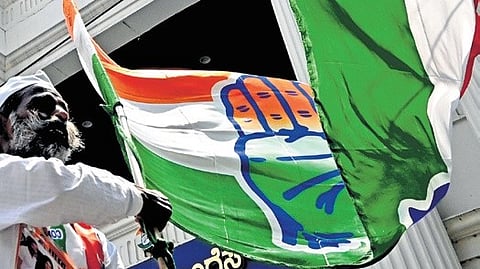

Amid persistent speculation over leadership change and cabinet reshuffle, all eyes are on the Congress central leadership. It is hard-pressed to end the uncertainty, one way or another, especially once the dust settles after the assembly election results on May 4. In the midst of that strategic political manoeuvring, the party’s leaders in the state anxiously await the bypoll results, especially in the Davanagere South Assembly segment, which has sent tremors through the party’s echelons, particularly concerning its core support base -- the minority community.
Rarely do byelections in one or two constituencies disturb the sleep of the ruling party, which enjoys a massive majority with 134 legislators in the 224-member state assembly.
More than the outcome of the polls, a shift in even a section of minority voters may signal an impending crisis, with implications far beyond the assembly segment.
Normally, the ruling parties have an advantage in the bypolls. While that would be known by Monday afternoon, senior Congress leaders, who have worked extensively in Davanagere, admit to possible drift in some minority votes.
The voting pattern in the Central Karnataka constituency, with a significant number of minority voters, would be closely analysed by the parties, especially Congress.
Given the gravity of the situation, Congress took a slew of measures after the voting on April 9, without waiting for the May 4 results. The party MLC Abdul Jabbar, who was accused of anti-party activities, resigned as the chairman of the KPCC Minority Cell, and was suspended from the party’s primary membership.The Minority Cell formed under his leadership was also dissolved with immediate effect. Action was taken against some local leaders in Davanagere. Not just that, Chief Minister Siddaramaiah sacked MLC Naseer Ahmed as his political secretary.
Housing, Waqf and Minority Affairs Minister Zameer Ahmed Khan’s role in the bypolls also came under the scanner, although no action was taken against him.
Apparently, the measures were taken based on reports from the party leaders, and the CM also got information from the Intelligence Wing of the Police Department about leaders engaging in anti-party activities. Some Congress leaders were even accused of working for SDPI and Independent candidates.
“… It is only one assembly constituency. The government is not going to fall, but party discipline is very important. There was no need to wait for results to take action. Some minority votes may have moved away, but we will definitely win. Results will be analysed in detail to understand the voting pattern and take appropriate measures ahead of the 2028 assembly polls,” said a senior Congress leader in the know of developments.
Although Congress leaders in the state insist that the minorities will always vote for Congress, as it is the only party that can counter the BJP and stop it from coming to power, that belief could be shaken even if a small section of minority voters in Davanagere sways away from the Grand Old Party.
While this may not make a significant difference to election results, it could signal that Congress is not the only option for the community when there is an alternative, especially if the party fails to take them into confidence. In Davanagere, Congress candidate Samarth Shamanur is banking on the consolidation of Lingayat and Kuruba community votes, as well as support from the minority community. Though a small section of minority voters may have drifted away, the SDPI is not seen as a credible alternative to Congress.
Some leaders in the community feel that Congress took the Muslim community, which favoured them in every election, for granted. They even warned that if the party fails to take corrective measures, the community would respond accordingly during the elections. In Karnataka, Congress and Chief Minister Siddaramaiah enjoy the full backing of the community, especially after Janata Dal (Secular) joined the NDA.
Prior to JDS joining hands with the BJP, a section of minority voters backed the regional party. In the aftermath of the developments during the Davanagere bypoll, the JDS would try to woo the minorities, while other smaller parties could attempt to dent what Congress considers its strong support base.
For now, the focus is on the outcome of the fiercely fought elections in West Bengal, Tamil Nadu, Assam and Kerala, which would have implications for national politics. In Karnataka, the spotlight is also on the counting of votes on Monday, as Congress and BJP are confident of doing well.
Unlike other elections, these bypolls are not just about the results but also about the voting pattern among minorities and how voters in the two constituencies responded to the issues raised by the government and the opposition. A clearer picture will emerge after the results on Monday.
