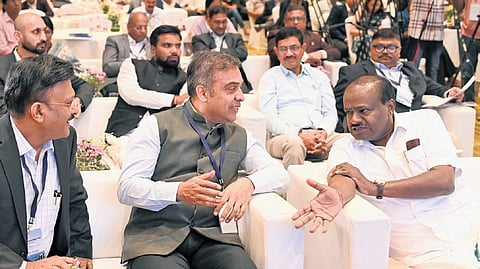

BENGALURU: The Union Government has approved Karnataka’s proposal for the installation of 1,243 EV chargers with an outlay of Rs 123 crore under the PM E-DRIVE initiative.
Speaking at a national conference on enabling EV charging infrastructure under the PM E-DRIVE Scheme here on Tuesday, the Union minister for Heavy Industries and Steel, HD Kumaraswamy, said the Ministry of Heavy Industries was developing the ‘Unified Bharat e-Charge’ platform to enable EV users to discover charging stations, access multiple charging networks and make payments through a single interface.
Overall, proposals worth Rs 503 crore for 4,874 EV chargers across states and Central Public Sector Enterprises (CPSEs) have been cleared, he said. States including Rajasthan, Andhra Pradesh, Uttar Pradesh, Gujarat, Kerala, Telangana, Karnataka and Tamil Nadu, along with CPSEs such as HPCL, IOCL and BPCL, are part of the approved proposals.
The minister also said the Rs 10,900 crore PM E-DRIVE Scheme was accelerating the adoption of electric two-wheelers, three-wheelers, buses and trucks while building a nationwide charging network, with Rs 2,000 crore earmarked specifically for EV public charging infrastructure.
The minister also highlighted key initiatives, including the Rs 18,100 crore PLI ACC Scheme for battery manufacturing, the Rs 25,938-crore PLI Auto Scheme for cleaner vehicles and the Rs 7,280-crore REPM Scheme for rare earth magnet manufacturing.
He also acknowledged the role of oil marketing companies and private players in strengthening the EV ecosystem. Under the FAME-II scheme, OMCs have installed 8,932 EV chargers nationwide, including 721 in Karnataka.
‘Right to Charge’ policy may boost apartment EV adoption Industry leaders at the conference on Tuesday highlighted home charging access as a major challenge in scaling electric vehicle adoption in India and called for the introduction of “right to charge”.
At a panel discussion, Omkar Shaligram of Tata Motors said nearly 90% of EV charging happens at home, but apartment residents in cities like Bengaluru, Mumbai and Delhi face challenges getting approval to install private chargers.
Referring to a recent incident involving the removal of EV chargers in apartments, he said the issue was social and regulatory, urging a “right to charge” framework for residential complexes.
The Federation of Private Transport Associations urged the Centre and Karnataka government to provide subsidies for converting LPG-run autos and taxis to CNG and EVs amid rising LPG prices and shortages triggered by the ongoing war situation.
Federation president S Nataraj Sharma said LPG had become scarce and unaffordable, pushing drivers and vehicle owners into financial distress. He said recent appeals by Union Minister Pralhad Joshi, senior Union Energy Ministry officials and Prime Minister Narendra Modi encouraging adoption of EVs, public transport, carpooling and CNG had added urgency to the transition.
The federation stated that auto and taxi drivers were willing to shift to EV and CNG vehicles, but financial assistance from governments was necessary. Leading a delegation, the federation met transport minister Ramalinga Reddy on Tuesday and submitted a request letter urging him to provide subsidies.
