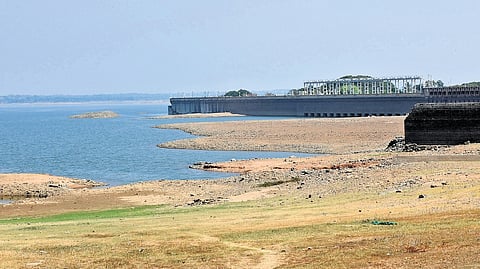

BENGALURU: The water level in Krishna Raja Sagar (KRS) reservoir has sharply depleted to 21.9 tmcft as against its gross capacity of 49.45 tmcft, raising concerns over drinking water and irrigation in the Cauvery basin districts, with another eight months to go before the onset of the next monsoon.
KRS and the Kabini dam supply drinking water to several districts in Karnataka and are crucial for meeting Tamil Nadu’s water requirements. In both the dams water levels are reaching dead storage.
Adding to Karnataka’s concerns, the Cauvery Water Regulation Committee (CWRC) on Friday directed the state to release 3,000 cusecs of water daily for the next 15 days starting from Saturday (November 7). This would mean releasing nearly 4 tmcft of water from the Cauvery basin reservoirs, putting further pressure on the already depleted storage.
According to data from the Karnataka State Natural Disaster Monitoring Centre (KSNDMC), the four major reservoirs in the Cauvery basin has 58 tmcft as against its gross capacity of 114.57 tmcft. During the corresponding period last year, the reservoirs had 111.36 tmcft of water.
The storage level in the KRS reservoir is expected to decline further in the coming months. Bengaluru, Mandya, Mysuru and Bengaluru South districts together require approximately 3 tmcft of water every month to meet their drinking water needs.
G S Srinivasa Reddy, former director, KSNDMC, said reservoirs in the Cauvery basin would normally be 90 per cent full or more during November at the completion of south west monsoon. “Now, the storage is only 44 per cent. The major rainfall season is over by October and we do not expect much rainfall in the next eight months.
The inflow into the reservoirs has also declined by nearly 60 per cent this year. Evaporation and other water losses could further reduce the available storage. The numbers are scary,” he said.
The groundwater situation has added to the concerns. Groundwater recharge, which normally peaks during November, has been relatively poor. Due to weaker southwest and northeast monsoons, farmers and other users had to depend heavily on borewells. This, in turn, has resulted in increased groundwater extraction. This trend is likely to continue in the coming months, further aggravating the water crisis.
During its submission before the CWRC, official sources said that Karnataka informed the committee that inflows into its four major Cauvery reservoirs were below the 30 year average. More than 55 taluks in the Cauvery basin are facing severe drought.
Dinesh Gooligowda, Congress MLC from Mandya, said that in 2025, KRS was full three times and as against 177.25 tmcft to Tamil Nadu, the state had released 341 tmcft. “This time, we do not have sufficient water. The government has to obey court orders and at the same time, it has to take care of farmers’ welfare. Chief Minister DK Shivakumar is expected to discuss the issue with the legal team and proceed,” he said.
Water Resource Minister N Cheluvarayaswamy was not available for comment since he is out of the country.
Official sources in the Water Resources Department said agricultural activities had been taken up on around 2.75 lakh hectares in the Cauvery basin, of which only 58 per cent had access to Cauvery water. The government is considering promoting micro-irrigation to reduce water consumption. However, the adoption of water-saving practices remains a challenge, with both farmers and the government yet to make significant progress in this direction.
Four reservoirs from Cauvery basin includes KRS, Kabini, Harangi and Hemavathi that serves to Mysuru, Kodagu, Chamarajanagar, Hassan, Mandya, Tumakuru and other districts.
