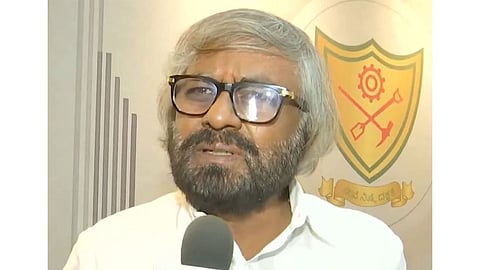

BENGALURU: Ahead of Children’s Day on Saturday, Rural Development and Panchayat Raj Minister Eshwar Khandre launched a ‘Children’s Grama Sabha’ (village panchayat) in Jakkur, Bengaluru, on Friday.
Similar panchayats for children will be conducted at 5,927 gram panchayats in the state over the next 10 weeks, till January 24, where their concerns would be heard and acted upon, according to Khandre.
“Children are not merely citizens of the future, but are citizens of the present as well. Therefore, rather than viewing children solely as beneficiaries of panchayat facilities, they should be treated as active partners who can express their opinions and raise questions regarding the development of their villages,” Khandre said.
He also attributed the establishment of lakhs of schools and hospitals to Nehru.
Through the upcoming sessions, school students will be introduced to concepts like children’s rights, sanitation, and rural development. “The initiative also aims to raise awareness about issues like child marriage and child labour, thereby preparing children to contribute to the creation of a better society,” Khandre said.
He also listened to the children’s concerns, and said he had ordered the construction of clean toilets and drinking water at state schools.
The minister urged children to develop environmental consciousness and avoid using single-use plastics, which pose a grave threat to the entire world.
“They should urge their parents and guardians to stop using single-use plastics and insist that trees not be cut down,” Khandre added, stressing the importance of water conservation, citing the scant rainfall in Karnataka this year.
Khandre said, “Every question raised by children during the state-wide Children’s Grama Sabhas must be taken seriously and not overlooked. Most children studying in Bengaluru have no concept of what a village is, nor are they aware of how gram panchayats function.”
Khandre explained the traditional roles and occupations of community members in a village to the students, including the roles of farmers, dairy farmers, blacksmiths, washerfolk, and village administrators/record-keepers.
