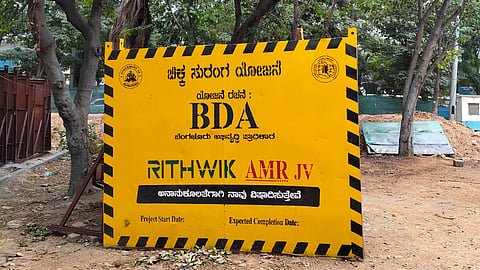

BENGALURU: Two technical reports, nine months apart, on the proposed 2.2km Hebbal short tunnel, have both flagged the absence of an Origin-Destination (O&D) study, which is essential to establishing actual travel demand, and assess the project’s utility.
Indian Institute of Technology, Bombay (IIT-Bombay) and BMS College of Engineering (BMSCE) had technically evaluated the short tunnel.
The Final Report of the Technical Committee by BMSCE on the construction of the short tunnel, signed on December 3, 2025, and accessed by TNIE has, among its key observations and suggestions, recommended that O&D studies be conducted using any suitable method.
It further states that a travel demand forecast and mode-split estimates for different user groups, including cars, two-wheelers, buses and freight, are necessary to identify potential beneficiaries.
A mode-wise O-D matrix and projections of the traffic the proposed underpass is expected to carry in future are also required to establish its need and justify the project.
Similarly, the IIT-Bombay study, titled ‘Integrated Traffic Microsimulation Study – Bengaluru Hebbal Flyover and Hebbal Short Tunnel’, dated August 10, 2026, has also called for an O&D survey as part of further studies.
‘Decisions on infra projects should be based on detailed studies’
It notes that neither (short tunnel & elevated corridor) of the Detailed Project Reports (DPRs) contains such a survey and the study has, therefore, assumed a traffic diversion range of 50-80 per cent.
An O&D survey, it says, would replace this broad assumption with a derived estimate and do more to strengthen confidence in the recommendations.
Apart from recommending an O&D, BMSCE’s study makes many other suggestions, while the committee concluded that the short transitory underpass project can be assessed to be a viable proposal in light of the mentioned precautions and suggestions.
Experts said an O&D study is essential for understanding travel patterns and assessing the need for infrastructure projects. They also stressed that it should be conducted over a period of time to account for variations in traffic.
“An Origin-Destination study is very important in traffic planning as it establishes where commuters are travelling from, where they are headed and why they prefer a particular route.
Traffic cannot be assessed based on a single-day count, as volumes vary across weekdays, weekends, holidays and different peak hours.
The study should capture these variations over a period of time to arrive at an average and reliable picture of travel demand. It also helps identify alternative routes that can be improved to divert traffic.
Decisions on infrastructure projects and their design should be based on such detailed studies, rather than assumptions or isolated traffic readings,” said Prof MN Sreehari, adviser to the Karnataka government for Traffic and Transport Infrastructure.
Independent mobility expert Satya Arikutharam said the proposed Hebbal short tunnel and elevated road were based on unreliable baseline traffic studies.
“First, the traffic surveys were conducted when the new loop from the airport side was still under construction. Second, the speed-delay survey exaggerated the corridor-level congestion due to construction activities at the time.
Third, traffic studies failed to conduct an Origin-Destination survey, which led to arbitrary assumptions about the level of use of the proposed facilities,” he said.
He also pointed to a capacity mismatch between the tunnel, which has three lanes in each direction, and the elevated road, which has two lanes in each direction. He said the issue was further compounded by the inadequate merge length of 80 metres.
BMSCE Committee: Key observations & suggestions
Geotechnical safeguards: Conduct detailed borehole and soil investigations near Hebbal Lake and take precautions against water seepage and soil collapse
Additional investigations: Make it mandatory for selected contractor to conduct further sub-soil studies and submit designs for earth-retaining measures
Waterlogging: Include adequate dewatering and pumping arrangements in the DPR, in line with IRC guidelines
Excavated soil: Prepare a plan for storage, reuse and disposal of excavated material, including identified disposal sites and drainage arrangements
Environmental assessment: Conduct an Environmental Impact Assessment to identify and address potential environmental concerns
Cost-benefit analysis: Compare toll and toll-free tunnel options with a combination of short underpasses and surface road, factoring in long-term operation and maintenance costs
