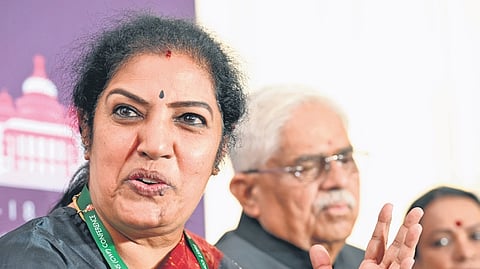

BENGALURU: Calling for political consensus to expedite the implementation of the 33% reservation for women in Parliament and State Assemblies, Dr Daggubati Purandeswari, chairperson of the Commonwealth Women Parliamentarians (CWP), India Region, on Wednesday urged all political parties to delink the Women’s Reservation Act from the Census or expedite the delimitation exercise to ensure that women do not have to wait until 2030 to enter legislatures in greater numbers.
Addressing the media after the valedictory of the first CWP India Region conference at the Banquet Hall of Vidhana Soudha in Bengaluru, Purandeswari said the legislation had already been passed but its implementation was linked to the Census and delimitation exercises.
“The Women’s Reservation Bill has been passed. But, yes, I do agree that it has been linked to the Census. If it is going to be Census 2027, then probably reservation for women will come into play only in 2030. That is the reason why we are requesting all parties to come together and delink it from the Census, either by going with the 2011 Census or by taking up delimitation immediately and linking it with women’s reservation,” she said.
Appealing to women across political parties to unite on the issue, she said the conference had called for rising above political differences on matters concerning women’s representation.
Asked about the demand for internal reservation within the 33% quota, Purandeshwari said the priority should be to secure the overall reservation first. She, however, maintained that the country had made considerable progress in women’s political representation following the 73rd and 74th Constitutional Amendments, which provided for reservation in local bodies.
“Where we had no women, we have women represented today. We have crossed 33% and are seeing even 50% reservation in certain states, including Karnataka. But the pace of progress is something we can always debate and discuss,” she said.
The two-day conference, the first national-level gathering of the CWP India Region since its formation, brought together around 109 women MPs and MLAs from across the country.
International participants included UN Women representative Shoko Ishikawa and Grace, an MP from Malawi and chairperson of the CWP African Region, besides four other African MPs who joined online.
‘Cybersecurity threats discouraging women from entering public life’
Cyberstalking, phishing, deepfakes, image morphing and online body-shaming have emerged as major deterrents to women’s participation in public life, Purandeswari said. The conference discussed how technology, while empowering women in education, healthcare and finance, was also increasingly being misused to target women, particularly those holding public positions.
One of the suggestions was to explore the integration of AI with social media platforms to prevent the circulation of misinformation and abusive content. A special session at the conference focused on menopause, a natural phase in women’s lives that continues to remain surrounded by social taboo, Purandeswari said. She said the discussion also highlighted the need to sensitise men and families.
