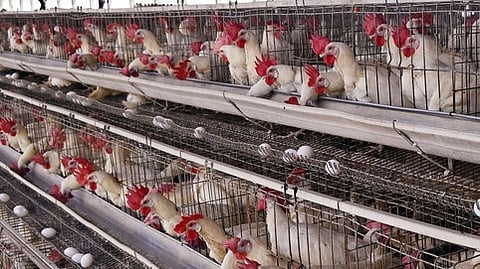

BENGALURU: With severe drought conditions affecting Karnataka and rural families facing livelihood challenges, the State government plans to create sustainable livelihood opportunities for vulnerable households to prevent distress migration in search of work. The State government is looking at constructing thousands of sheds for poultry and dairy farmers in villages, generating jobs for people in rural areas.
Under the initiative, livestock sheds will be constructed on land belonging to self-help groups (SHGs) in villages and gram panchayats. The RDPR department will bear the labour and material costs under the VB-G RAM G scheme. The initiative aims to enable vulnerable families to create livelihood assets in their villages and subsequently take up income-generating activities with support from the Animal Husbandry department and other government schemes.
The government plans to facilitate the construction of sheds for sheep and goats, cattle and poultry, particularly to benefit landless agricultural labourers and other vulnerable rural households. The programme will be implemented under VB-G RAM G in coordination with the National Rural Livelihoods Mission (NRLM) and Department of Animal Husbandry and Veterinary Services.
In a letter to chief executive officers (CEOs) of all zilla panchayats, Principal Secretary Pankaj Kumar Pandey said the El Niño effect and severe drought conditions had contributed to migration among landless agricultural labourers and poor rural families.
Preventing such migration by providing sustainable livelihoods and employment opportunities within villages is a priority for the state government, he said.
Pandey directed district officials to identify vulnerable families likely to migrate and assess their suitability for livelihood-based activities. Depending on their capabilities and requirements, eligible families can be supported in creating assets such as livestock sheds and undertaking agricultural and allied activities.
Officials have also been instructed to identify eligible landless agricultural labourers and vulnerable rural households with the support of self-help groups. They have been asked to coordinate with NRLM self-help groups, community organisations and the Animal Husbandry department to implement the programme at the gram panchayat level.
