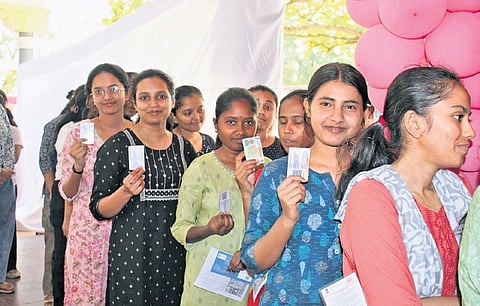

HUBBALLI: A significant number of votes was rejected in the preferential voting held for four constituencies of the Karnataka Legislative Council, with South East Graduates’ constituency recording the highest number of invalid votes, followed by West Graduates’ constituency.
This is by far the most concerning trend in constituencies of educated voters, comprising teachers and graduates.
According to available figures, 20,076 votes were rejected in South East Graduates’ constituency, accounting for 15.19 per cent of the votes polled. In West Graduates’ constituency, 10,245 votes (13.9 per cent) of polled votes were rejected.
Bangalore Teachers’ constituency recorded 1,857 rejected votes, or 8.10 per cent, while North East Teachers’ constituency saw 1,873 rejected votes, or 6.19 per cent. However, the data showed that the number of invalid votes is higher in graduates’ constituencies than teachers’ constituencies.
Political analysts attribute the high rate of rejection to voters’ unfamiliarity with marking preferences on the ballot paper. Unlike conventional voting, preferential voting requires electors to mark preferences in numerical order.
Ballots may be rejected if voters fail to mark their first preference correctly, use the same preference number for multiple candidates, leave the ballot ambiguous, or make markings that violate prescribed instructions.
The figures highlight the need for greater voter awareness, particularly among graduates and teachers participating in Legislative Council elections, they added.
Political leaders say that despite clear instructions on how to mark the ballot paper, some voters appear to have deliberately invalidated their votes, while others may have made mistakes unintentionally.
It is also believed that some voters chose to express their anger by deliberately casting invalid votes, rather than abstaining from the election.
