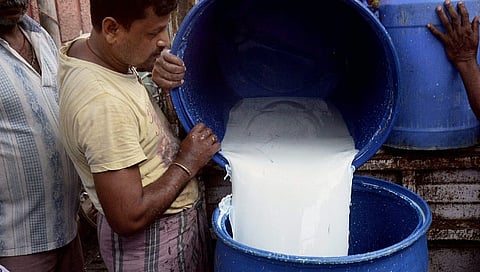

BENGALURU: The Karnataka Cabinet chaired by Chief Minister D K Shivakumar on Thursday has approved an Rs 8-per-litre hike in milk procurement prices, of which Rs 7 will go directly to dairy farmers and Rs 1 will be allocated to milk unions to meet operational expenses, including packaging and transportation.
The revised rates will come into effect on November 1, Bengaluru Development and Parliamentary Affairs Minister Krish Byre Gowda said while briefing press after the cabinet meeting.
With the revision, the procurement price paid to farmers will increase from Rs 35 to Rs 42 per litre. Including the existing state government incentive of Rs 5 per litre, farmers will effectively receive Rs 47 per litre.
The price revision is also expected to increase the retail price of milk to around Rs 54 per litre, although the final selling price will be decided by the respective milk unions, taking into account factors such as fat and solids-not-fat (SNF) content.
Gowda said the decision was taken in view of the distress faced by dairy farmers amid severe drought conditions, rising input costs and a decline in milk procurement.
“About 228 taluks have been affected by drought, and the El Niño effect and summer conditions have also affected milk production. Daily milk procurement has declined by around 10 lakh litres. In this situation, it is our responsibility to support dairy farmers,” he said.
He said dairy farmers had been demanding a revision in procurement prices and had staged protests in Bengaluru. The government had held several rounds of discussions with the milk unions and concerned ministers before arriving at the decision.
“Farmers were demanding an increase of Rs 10 per litre. After examining their demand and the financial implications, the Cabinet decided to increase the price by Rs 8 per litre, of which Rs 7 will go to farmers and Rs 1 to milk unions,” Gowda said.
He said the Rs 1 allocated to milk unions would help them meet the rising costs of packaging, transportation, fuel and other operational expenses.
Karnataka's milk price remains competitive
Gowda said milk prices in Karnataka remained lower than those in several other states, even after the proposed revision.
Citing comparisons, he said milk was priced at around Rs 59 per litre in Delhi and Maharashtra, Rs 57 in Gujarat and Rs 64 in Telangana. Prices in Kerala were around Rs 56 per litre, while some competing brands charged considerably more.
“Karnataka's milk price will be around Rs 54 per litre. Even after the revision, it will remain lower than prices in several other states and competing brands,” he said.
He added that the decision to increase procurement prices was an independent decision of the milk unions, which operate autonomously. The government was facilitating support for farmers, he said.
“Milk unions belong to the dairy farmers. They have to ensure that farmers receive a remunerative price while also meeting the costs of processing, packaging and transportation,” he said.
Gowda said rising fertiliser and other agricultural input costs had added to farmers' difficulties. The government had therefore decided to extend support to dairy farmers despite the challenging economic situation.
Separate corporation for vulnerable tribal groups
The Cabinet also approved the establishment of the Karnataka Adivasi Development Corporation to focus on the welfare of Particularly Vulnerable Tribal Groups (PVTGs) and tribal communities living in forests and forest-fringe areas.
The corporation will cover communities including Irula, Soliga, Jenu Kuruba, Kadu Kuruba, Kudiyas and Siddis, among others. An estimated 2.82 lakh people belonging to these communities are expected to benefit.
The government has earmarked Rs 33.36 crore for the corporation's initial activities.
Gowda said a separate corporation was necessary because these vulnerable communities often struggled to access benefits available under broader Scheduled Tribe welfare programmes.
Rs 61 crore for Bengaluru water reservoirs
The Cabinet approved Rs 61.50 crore for two drinking water infrastructure projects in Bengaluru under the Bangalore Water Supply and Sewerage Board (BWSSB).
Of this, Rs 22.50 crore has been sanctioned for a five-million-litre-capacity reinforced cement concrete ground-level reservoir at Kaval Byrasandra in the Pulakeshinagar Assembly constituency.
Another Rs 39 crore has been approved to demolish the existing masonry reservoir at the Banashankari service station and construct a new 22-million-litre-capacity RCC reservoir.
The Cabinet also approved Rs 51.37 crore for constructing a 10-million-litre-per-day sewage treatment plant at Kacharakanahalli in the Sarvagnanagar Assembly constituency, including seven years of operation and maintenance. The facility is intended to prevent untreated sewage from entering local lakes.
Project K-Monitor to assess welfare schemes
The government has approved Rs 14 crore for Project K-Monitor, an evaluation programme to assess the impact of major government schemes, including the guarantee programmes.
The initiative will cover all 224 Assembly constituencies and track beneficiaries to determine whether schemes are reaching the intended recipients and how they are affecting their social, educational and financial circumstances.
The study will cover around one lakh beneficiaries, with detailed feedback collected from 60,000 respondents.
Gowda said the exercise would go beyond measuring implementation and examine the actual impact of government programmes.
“Should we blindly spend public money collected through taxes without evaluating its impact? We need to know whether the schemes are making a difference in people's lives. If there are gaps in implementation or benefits are not reaching the intended beneficiaries, we should make the necessary changes,” he said.
The findings will help the government assess the effectiveness of individual schemes, identify shortcomings and introduce corrective measures where necessary.
New waste collection vehicles for Bengaluru
The Cabinet approved 10 packages for waste collection and transportation tenders across Bengaluru's Assembly constituencies.
The contracts will run for seven years and require operators to deploy new, higher-capacity three- and four-wheeler vehicles equipped with GPS tracking systems.
Gowda said the existing waste collection system had several shortcomings, including the use of old vehicles, inadequate collection capacity and failure to implement GPS tracking despite it being mandatory.
The new arrangements are intended to improve door-to-door waste collection, ensure vehicles cover their designated routes and strengthen monitoring.
The Cabinet also approved Rs 16.04 crore for purchasing 9,243 sewing machines under the Devaraj Urs Backward Classes Development Corporation's scheme to support self-employment among women.
Belagavi winter session from November 30
The winter session of the Karnataka Legislature will begin in Belagavi on November 30 and continue for 15 days, Gowda said.
The Cabinet also approved revised estimates of Rs 228.95 crore for the construction of the Kranthiveera Sangolli Rayanna Sainik School at Sangolli in Bailhongal taluk of Belagavi district.
