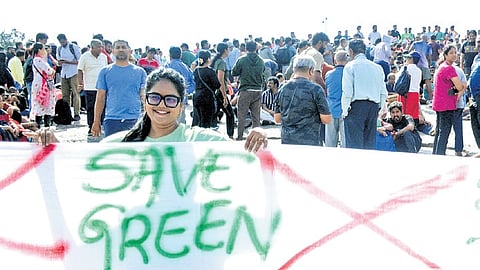

BENGALURU: “When an alternative already exists, the proposed Metro Red Line, the state government has made a mistake by pursuing the tunnel road, for which it has passed the Karnataka Parks (Preservation) (Amendment) Bill, 2026, allowing it to use 5 per cent of parkland for public utilities, including Lalbagh,” opine experts.
They said the government should complete pending Metro and Suburban Rail projects, electrify the BMTC fleet, and stressed that Bengaluru does not need a tunnel project at all.
Environmentalist Akshay Heblikar opposed the proposed amendment alienating parkland. “Parks were created to provide citizens with open and green spaces, and should not be repeatedly diverted for infrastructure projects. Instead of relying on large tunnel projects, the government should focus on improving existing roads, introducing one-way systems, developing interconnected flyover loops and redesigning major junctions to help reduce traffic congestion in the city,” he said.
Founder and member of Bengaluru Praja Vedike, NS Mukunda, said the Bill was passed solely to enable the use of Lalbagh land for the tunnel project, while other experts echoed the same view.
He said the government should first complete all pending Metro, Suburban Rail projects and replace the entire BMTC fleet with electric buses before pursuing “fancy projects” like the tunnel road, which he said was not the solution.
He opposed the proposal to divert 5 per cent of parkland, noting that the city has nearly 1,400 acres of public parks and 5 per cent would amount to around 70 acres. “The government should create more parks and plant trees along roads to mitigate the effects of climate change,” said Mukunda, urging the authorities to declare all parks as heritage areas.
Move people, not vehicles: Mobility experts
Independent mobility expert Satya Arikutharam said the government should first drop the proposed 17-km tunnel road project, as an alternative already exists in the form of the proposed Metro Red Line. The Metro corridor, which is part of Bengaluru’s Comprehensive Mobility Plan, would serve the North-South corridor more effectively than the tunnel road, he said.
He also pointed out that the Metro alignment was consciously planned to avoid Lalbagh, indicating that public transport infrastructure could be designed without affecting the city’s important green spaces. “When an alternative already exists, the government has made a mistake by pursuing the tunnel road. It is highly exclusionary as it is mostly meant for cars,” he said.
Arikutharam said nearly 60 to 70 per cent of Bengaluru’s vehicles are two-wheelers and autorickshaws. If these users are excluded from the tunnel, he questioned whether the project would provide meaningful relief from surface-level traffic congestion.
The government should drop the tunnel project as it fails to address the city’s traffic, said mobility expert Prof Ashish Verma, convener, Indian Institute of Science’s (IISc) Sustainable Transportation Lab. He said simulation modelling conducted by his team showed that the tunnel would attract very little traffic if the proposed toll was around Rs 300 one way.
“It would operate under almost free-flow conditions, which essentially means only very rich people and VIPs would be able to use it,” he said. A regular commuter using the tunnel twice a day could spend around Rs 15,000-20,000 a month, making it unaffordable even for well-paid professionals, he said.
As a result, the project would not significantly improve traffic conditions on the surface. Instead, the government should prioritise an underground inner-ring Metro corridor already included in Bengaluru’s 317-km Metro master plan under the Comprehensive Mobility Plan, he added.
The professor further noted that the corridor, originally proposed by mobility experts, could provide better connectivity within the core city. Bengaluru needs a dense, “spider-web-like” mass rapid transit network comprising radial and circular lines, he said. Verma also questioned the need for tunnel roads altogether, arguing that they are inefficient in terms of both space and cost.
One lane of a road tunnel can carry around 1,800 passengers per hour per direction (PPHPD), compared with up to 69,000 passengers for a Metro corridor of equivalent width, a nearly 40-fold difference. “The focus should be on moving people and goods, not maximising the movement of vehicles,” he said.
When does Bengaluru need a tunnel?
Asked when Bengaluru would ideally need tunnel infrastructure, Satya said tunnels could be considered in locations where a short section would demonstrably improve the efficiency of the wider road network, rather than merely shifting congestion from one location to another.
He added that such decisions should be based on scientific transport modelling. He criticised the Detailed Project Reports prepared for the tunnel project, describing them as being of poor quality and arguing that traffic forecasts were unreliable.
