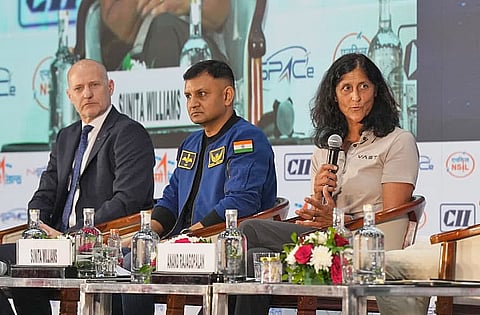

BENGALURU: Captain Sunita Williams, US Navy (retired), NASA astronaut and Vast astronaut advisor, on Wednesday said that while working at the International Space Station (ISS), she found a lot of rigidity and bureaucracy, as it has been operational for the last 25 years, making it difficult to change things. However, when future space stations are built, astronauts should be given the freedom to analyse and make decisions rather than depend upon the ground control station. There should also be greater accessibility to data centres.
She said that, in one way, the bureaucracy is good as it makes the station safe and reliable. Over time, the station has developed, and as a result, it is busy. She added that it is difficult to implement major new ideas at the moment, but things are being worked upon gradually. With new stations, there are opportunities to build ideas from the ground up.
She was speaking at a discussion on “The Next Chapter of Space: A Conversation on Exploration, Science and Innovation” on the last day of the three-day-long 9th edition of the Bengaluru Space Expo.
Sunita said there are many technological interventions and data accessibility on Earth that are not available in space. She said, “On the ISS, there is no database.
Astronauts rely on communication with the ground. For future stations, to address communication delays, there is a need for a database onboard to troubleshoot things. The other thing is reliable 3D printing. This is because even printing on paper is hard in space. We need to design machines that don’t need gravity.
The third is, every time an experiment is done, data sets have to be relayed back to Earth for analysis. Astronauts should be able to do the analysis themselves in space.” She added that international cooperation is necessary for space missions to go to the Moon and farther into space as human beings and not as people from any one country. She said international cooperation also helps compare and learn about different modules, spacesuits and experiments.
Adding to this, Group Captain and Gaganyatri Angad Pratap said the ISS has taught humanity one lesson: that it is possible to work together to make things happen in space. Even the economically most powerful country could not go alone. There is a need to get Helium-3 from the Moon, which could solve a lot of problems on Earth for the next thousands of years. The ISS is now around 25 years old, and India is also setting up the Bharatiya Antariksh Station (BAS).
“To attain common targets, there is a need to work together. There is a need for collaboration on projects, research, deliberations and even to recreate an Earth-like scenario in space. We need all hands on board,” Pratap said.
VAST TO LAUNCH COMMERCIAL SPACE STATION NEXT YEAR
Tom Shelly, Vice President, Crew Partnerships, Vast Space, said the company was creating a space station and taking up spaceflight operations to demonstrate that it can be done independently, faster and more efficiently. Shelly said the company is five years old and is working to create the first commercial space station, Haven-1. It is scheduled to be launched next year. “We are trying to develop it quickly, safely and at a sustainable cost. It will be a platform for governments, private firms and individuals to undertake scientific research,” he said.

MINISTER SEEKS ISRO SUPPORT FOR STUDENT-SCIENTIST INTERACTION
Minister for Minor Irrigation, Science and Technology, Ajay Dharam Singh on Wednesday sought the support of ISRO to organise direct interaction programmes between students and scientists at science centres across Karnataka. He held a meeting with ISRO Chairman V Narayanan on Wednesday and submitted a proposal to enable students to learn from scientists about space science, research, satellite technology and career opportunities in science and technology.
Singh said that the government is also expanding the science centres, mobile planetariums and telescope-based learning initiatives to promote practical and interactive science education among students. He said that the Mobile Digital Planetarium programme had reached 3,282 schools and benefited over 5.46 lakh students and teachers. Under Providing Access to Telescopes programme, telescopes have been provided to KREIS schools, colleges, along with training for science teachers.
Five Australia-India space agreements signed
By the close of the three-day Bengaluru Space Expo on Wednesday, five agreements had been signed between three of the 12 companies that were part of the official Australian delegation and five Indian companies in the space sector. The delegation was led by the Australian Trade and Investment Commission (Austrade). Australia’s LatConnect 60 and India’s NewSpace India Limited (NSIL) are formally entering into an agreement that will enable LC60’s SWIRSAT mission to access and leverage NSIL’s ground-station infrastructure in India, supporting the mission’s operations and data downlink requirements. “Australia and India have built a strong foundation for cooperation in space, and the Australian delegation at BSX 2026 is about taking that relationship into its next commercial chapter. Our firms bring complementary capabilities across space value chain, and we see significant potential to connect Australian technology with India’s scale,” said Austrade’s Trade and Investment Commissioner Nathan Davis.