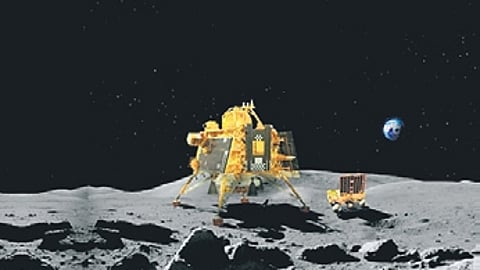

BENGALURU: Lunar exploration has opened the gates not just for new opportunities but also for new findings. In a recent report, researchers said the success of the Chandrayaan-3 mission has asserted the fact that the lunar surface has been relentlessly modified with meteroite and micrometeorite bombardments, which is a major geological process for the regolith formation.
Researchers also noted that the geochemical data provided additional insights about the Lunar crust and its diversity. The Lunar meteorites also provided valuable constraints on the mechanical properties of the Lunar materials, it noted.
“Such investigations provide essential insight into regolith behavior and material strength, which are critical for future in situ exploration and surface operations on the Moon,” researchers noted in the report -- Chandrayaan-3 APXS measurements reveal Lunar highland compositional diversity and meteorite connections -- published in Space Exploration.
They also noted that the large proportion of Lunar meteorites are feldspathic in composition and contain low concentration of KREEP components (rocks enriched with potassium, rare Earth elements and phosphorous). They also noted that many feldspathic Lunar meteorites are more magnesian than the Apollo samples.
They also noted that the promordial feldspathic crust of the Moon is said to have originated from floating plagioclase feldspar that crystalised from the Lunar Magma Ocean (LMO), resulting in the formation of the Ferron Anorthositic (FAN) crust.
The Feldspathic Highland Terrane (FHT)-- one of the lunar surface terranes, comprises of 60% of the Moon’s surface, which is prominent on the farside of the Lunar surface and is considered to be the large-scale geological manifestation of the FAN-rich primordial feldspathic crust, they noted in the report.
“The meteorites are defined as typical because they contain minimal mare and KREEP components. The comparison of average composition of FHT with the Chandrayaan-3 landing site reveals that the soils at the landing site are less feldspathic and contains lower normative plagioclase than FHT. The Ch-3 soils are found to be more mafic,” researchers said in the report and added that the magnesium oxide to iron oxide ratio was higher in the Ch-3 soils than the FHT averages. The additional olivine/pyroxene ratio on CH-3 landing site was also higher than the typical FHT, they noted.
The CH-3 mission had achieved a successful soft-landing of the Vikram lander at the Shiv Shakti point on the Lunar south pole on August 23, 2023 at 6.04pm at 69.37° S and 32.32° E, situated within the southern high-latitude highlands of the Lunar nearside. The Alpha Particle X-Ray Spectrometre (APXS) onboard the Pragyan rover measured the mean alumium oxide on the Lunar soil at the landing site.
