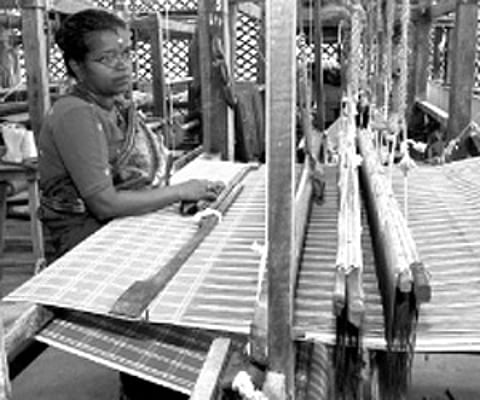

KOLLAM: The primary handloom societies in the district are facing a severe crisis owing to the shortage of working capital. The societies are not in a position to purchase yarn for weaving and to distribute the wages of the workers.
Earlier, there were around 150 primary handloom societies in the district. However, the number of functioning societies has come down to 20 over the years owing to the crisis the industry is facing and the remaining societies too are on the verge of closure.
The number of workers employed in the societies has also come down considerably. Ealrier, a society used to employ 50 to 75 workers on an average. Now, there are only ten or 12 workers.
Hantex, the apex society of the handloom societies, is refusing to procure the products of the primary societies. The crisis faced by the industry has been cited as the reason for this. The primary societies now mainly depend up on the festival seasons to sell their products. The Government used to announce 20 percent rebate for the handloom products during four festival seasons in the State.
However, the Government owes the societies huge amounts as rebate dues. In the district, this amount comes around Rs 15 lakh. With the shortage of working capital, the societies are finding it difficult to purchase yarns for production.
The Kollam Cooperative Spinning Mills stopped supplying yarns to the societies, as it has Rs 7 to 8 lakh dues from the societies. The societies have to remit a huge amount to the PF and ESI as dues and the workers employed in these societies are denied the benefits under the schemes. The Central and State Governments had provided a fund for clearing the PF and ESI dues of the societies. However, the Industries Department officials are refusing to remit the amount by raising the objection that the societies had not remitted the amount they collected from the workers in these accounts. They maintain that only if the societies remit that amount, they would be entitled to get the Government aid. It may not be possible for the societies to remit the dues, which are struggling for existence.
The existing wage structure in the industry is negligibly low. A worker gets only Rs 40 to 45 as daily wage. It was last revised three years ago with a hike of three rupees. The wage structure in other traditional industries such as cashew and coir is far better than this. Because of the low wages, workers are leaving the industry in search of other jobs.
The District Industries Centre is not providing any financial aid to the primary handloom societies in the form of grants or loans. Meanwhile, in other parts of the State, especially the Kannur handloom industry and Balaramapuram handloom industry manage to get Government funds even without engaging in production. The primary societies in those areas purchase products produced in the power looms and sell them as their own products in the market. The AITUC-led Kollam Jilla Kaithari Thozhilali Union secretary G.Udayakumar, who is also the president of the Veliyam Handloom Primary Society, told ‘Express’ that providing working capital to these societies, making arrangements for the purchase of yarn and setting up facilities for the sale of products are the three essential steps needed for the survival of the primary societies.
He also emphasised the need for modernising the industry.
