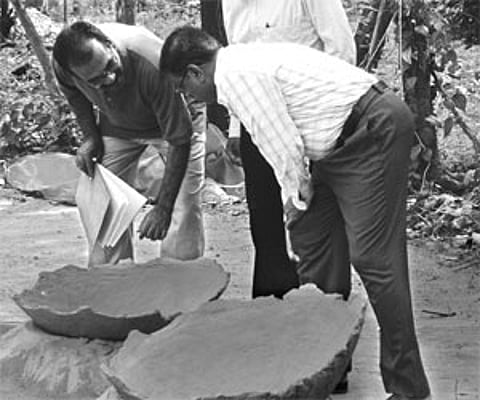

THIRUVANANTHAPURAM: The experts who visited the archaeological site of Pattanam on Sunday said that the evidence unearthed at Pattanam corroborates with the references on Muziris in Sangam literature and that the discovery of Muziris by the Kerala Council of Historical Research, is a major breakthrough in Indian Archaeology.
The team of multi-disciplinary experts from Tamil and Pondichery Universities, led by Tamil University Vice-Chancellor M Rajendran opined that the evidence found at Pattanam also corroborated with the evidence excavated in the Tamizhakam sites, namely, Korkai, Azhakamkulam, Poompuhar and Arikemedu. The evidence is definitive pointer to the connections of the region with the Mediterranean world, West Asia, Southeast Asia and Sri Lanka.
“I am personally surprised to see the huge quantity of glass and semi precious stone beads at Pattanam which goes well with those found at Kodumanal site excavated by the Tamil University,” he said.
K Rajan, eminent archaeologist and the Head of the Department of History, Pondicherry University reflecting on the brick structures exposed at Pattanam said that the dimensions of the bricks (40 x 20 x 7) and the triple grooved roof tiles are akin to those found at contemporary early historic sites like Uraiyur, Kaveripattinam and Arikamedu.
“The exceptionally fine quality of masonry and associated construction technology reveal the role of indigenous people in building up a flourishing trade network.
The cultural transformation from the Iron Age to the Early Historic Period discernable at Pattanam is unique to the Peninsular India,” he said.
The team, among others, included N Athiyaman, Professor and Head of the Department of Marine Archaeology, Tamil University and V Selvakumar of the Epigraphy and Archaeology Department of Tamil University who is also the co-director of the Pattanam excavations.
