
When Mehdi Hassan came to Kerala in 2000, the Pakistani Ghazal singer was suffering from a severe paralytic stroke. Naturally, his visit to the south Indian state was not to perform but to get treatment for his ailments — from a famous Ayurvedic hospital near Kozhikode. Soon, the Malabar town’s Islamic tradition and love for Hindustani music wooed him, and within weeks the celebrated vocalist paid a visit to the place. He was hardly mobile, yet was able to sing, which he did superbly well. Poignantly enough, that was his last live performance: Hassan leads a completely bedridden life today in his hometown of Karachi. Music-lovers back in Kozhikode still cherish that blissful evening, and hope the maestro, now 82, will recover and even revisit their city.
The story sums up the average Kozhikode resident’s love for music. It isn’t something new. Meetings with a few people would prove the city’s connection with music upcountry. Ahmad Bhai, a close friend of Mohammed Rafi, tells you how many muttamalas the cult singer ate when he visited his house in the late 1970s. Then there is Radio Koyakka, also an ardent Rafi fan, who never lets you leave his house without listening to rare songs from his 3,000-odd original gramaphone records. You also have Damodaran, the octogenarian harmonium player who will tell you about the saddest ditties M S Baburaj sang soon after coming back from his wife’s funeral.
Kozhikode has three religions, according to critic and activist Civic Chandran: theatre, football and Ghazal. “The first two have almost lost audience, but the third one thrives, thanks to the culturally rich Muslim community here. Such a heritage alone has ensured that anti-Muslim sentiments never touch this place,” he says, pointing out how keenly the denizens celebrate the anniversaries of icon musicians like Rafi, Kishore Kumar, Talat Mahmood and Baburaj.
Music of togetherness
A decade ago, no Muslim marriage was complete without a mehfil. But gone are the days that featured such entertaining cultural evenings ahead of festive occasions. The Malikappurams, or rooftop of houses that hosted mehfils, have gone vacant of late. But then there’s a reinvention happening. A new version of such soirees is finding regular venues in small clubs along suburbs like Manthottam, Kinasseri, Mankavu and Kallai.
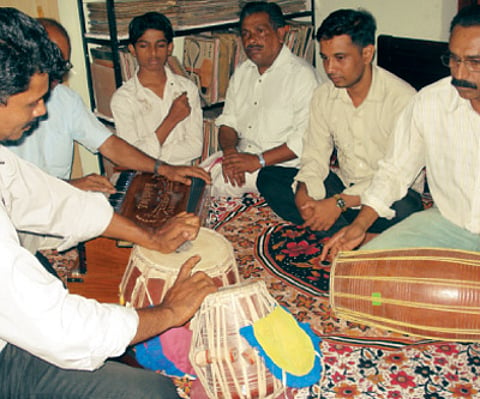
For instance, a little away from the city and close by the final resting place of Baburaj (1921-78), there is a small such club. Climb the rotting wooden staircase of Voice of Music, and you reach a small hall on the first floor. A four-foot-high wooden platform occupies almost half the room where two benches are kept in rows for the audience. A huge black-and-white photograph of Rafi hangs from the wall. Every evening, a group of youngsters from different parts of the city assemble here for the mehfil. They are from different walks of life, and not generally the well-off kind — daily-wagers, carpenters, cleaners, autorickshaw drivers, etc. “Most of us are not trained in classical music, but we learn through association,” says twentysomething Jaleel Mankavu, a singer and ardent fan of Baburaj. “There is a kind of togetherness we get from music.”
For Jamal, Baburaj is his dream guru. “I haven’t seen him but he is the soul of our music here. We have grown up listening to stories of a great tradition he started in the ’60s.” Chimes in Damodaran, a harmonist who had worked with Baburaj: “Those were the golden days. Musicians used to come from all over the country to Kozhikode. There were great art lovers to conduct events by spending from their own pockets,” trails off the 84-year-old bachelor, running his fingers over the instrument. ‘‘It used to be non-stop concerts that might last till the wee hours. Again, by morning, a new singer would appear from somewhere and the music would flow. I used to be in the club most of the days, and sleep only there.”
The tradition always pepped him up. But, otherwise, he believes life never treated him well. He now works as a marriage broker to meet day-to-day expenses. But then, there are many in Kozhikode who are broke like Damodaran. Hindustani musician Saratchandra Marathe lived the chunk of his life in this city, but managed to get a house only last year after the state government allotted him one. That, after sustained media reports about the dilapidated house he lived in as a tenant.
Radio koyakka
When it comes to Radio Koyakka, it is tough to beat him if the subject is Rafi (1924-80). For the huge repository of Rafi songs he has, Koyakka makes a curious remark: “Even today, If you want to listen to good Hindi songs, you have only one option: Radio Ceylon. I used to listen to Rafisaab and Lataji (Mangeshkar) a lot as a child, and got addicted to it. I have been to Delhi, Bombay and Madras to collect these rare 78 speed records.”
His music room, with two radios and gramophones and music players with high-quality speakers, preserves invaluable records. Black tea and sweets follow with every song. “We have mehfil every Sunday. It is called Purane Geet Sathiyaam,” he says. As he plays Rafi one after another, Koyakka’s friend’s mobile phone buzzes. The ringtone is a Malayalam song, and that irks Koyakka. “Rafisaab was a magician, none can beat him,” he tells the friend. To prove his point, Koyakka soon plays some difficult Rafi songs. “Hindi music has been ruined. R D Burman and Kishore Kumar did it with their fast numbers.”
A 4/6 album with old black-and-white pictures at Ahmad Bhai’s house will speak for himself. A young Ahmad with Rafi, Talat, O P Nayyar, Naushad, Noorjahan, Lata…the list goes like that. The most striking among them is the one that shows Rafi giving a punch to his namesake with a global fame: boxer Muhammad Ali. “As a child, I used to listen to (K L) Saigal and Noor Jehan and later Rafi. Once when I was in Bombay during a business assignment, I got to know that Rafi was staying in the adjacent building. I went to meet him. At the third floor, I saw him coming down with his family. I went straight and hugged him. The effect of that embrace lasted with me for long.”
A close friend of Rafi
Ahmad Bhai says the legendary singer was fond of muttamala. “While having food at my wife’s house in Thalassery (in neighbouring Kannur district), he finished a couple of this typical Malabari delicacy at one go. So simple, humble. He sang several high-pitch songs, but was very soft-spoken,” says Ahmad Bhai, who, amusingly, is a Manna De look-alike.
He has a posh ‘listening studio’, where he preserves his records. One can’t just go there and listen to music randomly. Ahmad Bhai is very particular about certain formalities. There are three chairs on a single array in the middle of the room with speakers arranged in various directions. “Let me try some welcome song,” he says. Soon the speakers become active with Rafi’s Baharon phool barsao. Ahmad Bhai listens to music every evening for three to four hours. For him, listening is an art. And he has a good count on the numbers of famous singers. A sample: “Rafi has sung between 6000 and 7000 songs. Asha Bhosle: 16,000, Lata Mangeshkar: 10,000, Talat: 840.”
Outside, a little away, at Mumbai Hotels, a popular biryani joint, its owner Muhammad Ashraff recalls a story his music buff father once told him. The man, Kunjahammad, was returning with Baburaj and two others from Mysore. By midnight, they crossed the Kerala border and reached Sultan Bathery. The town had gone to sleep. They walked to a house. An old man opened the door and Baburaj told him they were hungry. The man said there was nobody to cook. A tenacious Baburaj sat on the floor, opened his harmonium box and began singing. Within minutes, a grand dinner was ready.
Is Kozhikode losing its power of music now? “No,” says Ashraff, whose ‘Flash’ was once a favourite music store of many. “Those days, our Colombo Hotel was the main centre of mehfils and such activities. Now it has been closed down — like many clubs. But these days we have a lot of promising youngsters like Dr Muhammad Shakeel who can keep this tradition alive.” But music expert Jamal Kochangadi, editor of a regional daily called Thejas, senses a lack of interest among the new generation. “Today’s music has become a kind of fast-food.” But Ashraff and his friend Gulab N K, a Ghazal singer, are hopeful. “The foundation of the tradition is strong,” says Gulab, a Talat Mahmood specialist, who also runs Mehafil Orchestra in Kozhikode.
A big crack in the heritage, Civic Chandran notes, would ‘‘only let fundamentalism creep in.” Now, that’s dangerous, he adds. And one need not be an aesthete to agree with it.
— mtsaju@yahoo.com
The city’s curious Bengal connection
Baburaj, who composed many hit Malayalam film songs, was born on March 29, 1921, in Kozhikode. His early childhood was spent in poverty. His father, Jan Muhammed Khan, was a Hindustani musician from Bengal. Baburaj learned basic lessons of Hindustani music from his father from a very young age, but could not learn it for long as his father returned to his native state. In search of his father, Baburaj went to Bengal — and studied harmonium there. Back in Kozhikode, he started composing music for dramas in Malabar. In 1957, he composed music for the Malayalam film Minnaminungu. Being a
singer and harmonium player, Baburaj excelled in introducing Hindustani strains into Malayalam popular music. He died in 1978, at the age of 57.
