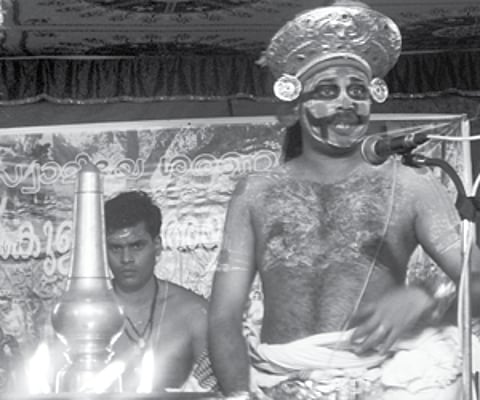

Ammannoor school is considered as the bold and sharp style of oral acting in the traditional art form of chakyar koothu. The pointed and timely criticism, inimitable acting style and crystal clear diction are the prominent features of this school. After the demise of Padmabhooshan Guru Ammannoor Madhava Chakyar the connoisseurs were eagerly waiting for a young voice from Irinjalakkuda Chaachu Chakyar Smaraka Gurukulam, established and expanded by Ammannoor.
Through the recently presented vivadam, the initial phase of purushaartha koothu, at Tripunithura Thamaramkulangara Sree Dharma Sastha temple, Ammannoor Rajaneesh Chakyar proved his acting potential and dynamism while strictly following the style of Ammannoor Madhava Chakyar, especially during the voice modulation. Rajaneesh presented vivaadam, Ganapathy prathal and Panchali sawayamvaram at the temple as part of the Bhagavatha Sapthaaha Yanjam.
While keeping the basic elements of Ammannoor style of story telling, Rajaneesh skillfully weaved the contemporary socio-political situations with the main story line of chakyar koothu. He used a simple and communicative form of pakarnnaattam, the unique acting technique used in koodiyattom. The major attraction of the five-day-long performance was the unbelievable transformation of an otherwise shy, introvert Rajaneesh Chakyar into the lively characters like Mekkanthala and Keezhkkanthala of the fools’ village, Anadheethi Mangalam.
The most striking element of chakyar koothu is the serene and age-old Malayalam used by the actor. “It is really a strenuous effort to present this Malayalam without the influence of modern language used in our day to day life,” Rajaneesh says.
It is quite difficult to avoid the usage of English, which is very common in modern life, says this MCA holder who sacrificed a glittering profession with an attractive salary just to follow the footsteps of his ancestors.
For perfect concentration while presenting a story our teachers trained us in nama japam in the wee hours of the day and also the rendition of selected tough Sanskrit hymns. “It is the rigorous training under the strict supervision of Madhavamman and Kuttamman that enabled me to present the koothu properly,” he adds. While narrating the vivadam of purushartha koothu, Rajaneesh spontaneously compared the foolish characters in the storyline with the contemporary characters who lead a ridiculous life in the society.
While answering a question about his flawless presentation of the intricate Sanskrit excerpts and voice modulation of myriad characters in the main story, Rajaneesh explained the strenuous training period during his student days at Chachu Chakyar Smaraka Gurukulam.
“It is the chanting of various shlokas for two to three hours early in the morning that provides energy for presenting the story in an effortless manner,” he says.
On the second day of the koothu while explaining the Ganapathy prathal, the satirical story of Vaishravana (brother of Ravana) who failed to provide a sumptuous feast for Lord Ganesha, Rajaneesh adopted the orthodox style followed by Ammannoor Madhava Chakyar.
Rajaneesh’s skill to observe the surroundings and to merge the situations and characters in the storyline is quite remarkable. Now Rajaneesh is readying to present the famous ashana purushartham at Irinjalakkuda Koothambalam. “As a member of Ammannoor Chakyar Madhom we have to present the debut performance of purushartha koothu in the koothambalam. Then only we can present them in other places,” Rajaneesh says.
The stylised presentation of vivadham and other prominent prabandhams (prose works) of celebrities like Melpputhur Narayana Bhattathiripad indicates a bright future for this young artist who takes strenuous effort to achieve perfection in each performance.
“I feel proud of my profession, to be a part of the thousand-year-old theatre tradition preserved and popularised by legends like the late Mani Madhava Chakyar, the late Paimkulam Rama Chakyar and finally my grand uncle the late Guru Ammannoor Madhava Chakyar,” he says.
sivadasvarma65@gmail.com
