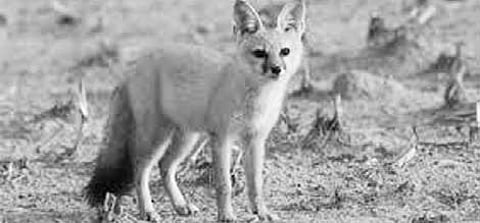

KANNUR: Once a common pest that held regular night raids in the croplands, the Indian fox (Vulpes Bengalensis) has now become very rare in the state, triggering fears among nature lovers that the animal might be facing a far greater threat than commonly perceived.
The little carnivore was common in shrubby areas and villages. It was also said to have adapted to human-made ecologies and had a high degree of tolerance towards human disturbances. But the sightings of the Indian Fox in Kerala have become alarmingly rare.
The Vulpes Bengalensis was last reported in Kerala on January 1 by a group of researchers from Periyar Tiger Reserve. Before that, it was spotted during a field study at Kavvayi river basin near Ezhimala by a field study team of the Society for Environment Education in Kerala (SEEK) in 2011, said V C Balakrishnan, secretary of SEEK.
In the absence of specific research data and field study, it cannot clearly said how threatened these animals really are in Kerala. But they have certainly gone down in numbers and have been pushed into the forests, experts said. There are a number of hypotheses put forth by animal watchers on the possible reasons for the withdrawal of these animals from villages. One of the most accepted theories is that the use of pesticides in vegetable farms must have wiped out a good number of Indian foxes from these croplands. Loss of habitats, rampant mining, degradation of grasslands and shrub forests and increasing urbanisation might have chased them from their intricate boroughs on the ground.
As the Indian Fox was a widely distributed animal, there was not much interest in the state towards research about the animal. Besides, scientific research on common species of animals are rare, even though you might find volumes on animals in protected areas and in forests, Balakrishnan said.
A 2012 study of Indian fox conducted by Dr H N Kumara and Dr Mewa Singh on the distribution, den characteristics and diet of the Indian fox in Karnataka emphasised the need for adequate management of the species before it also agains t the dubious endangered status. It often happens that the species considered as common with a wide range of distribution do not receive the same attention in management as compared to those listed as high priority species, they observed. In North Kerala, especially in Kannur, Indian Fox, commonly known as ‘Kurukkan’ in Malayalam indirectly prompted local artists to float their own theatre group and the unique ‘Vellari Nadakam’ was born in 1930s. The hilarious parody of upper caste forms of theatre took shape among villagers who kept awake in the nights to foil nocturnal raids of the Kurukkan on Vellari (cucumber) farms. The villagers who kept watch in the cucumber farms began the preparations for the play in the Malayalam month of Midhunam and the play was performed for the public on the same fields after the harvest after the month of Chingam, said K V Balakrishnan (Balakrishnan Pappinissery), an actor with Kannur Sanghachetana, who played a major role in ‘Ayancheri Vallyasmanan’ of Vellari Nadakam when it was re-enacted on stage by Dr T P Sukumaran a few years ago.
Dr “T P Sukumaran scripted the play in 1989 and we played it continuously across the state till one of our lead actors died in 2006. The final performance was in Karivellur in Kannur. There was no replacement for that actor and we had to stop staging it,” he said. Even as footprints left by the small animal are getting erased from our common memory with even the cultural manifests fast fading into oblivion, a group of researchers is preparing to take up the task of documenting the animal before it gets mentioned in the red-data book.
“We are planning extensive field studies on the Indian Fox in Kerala to study the possible threats to it. The field studies will begin in June,” V C Balakrishnan said. They fear that if they do not begin it now, the Indian Fox may have the same fate as Malabar Civet, which became extinct.
