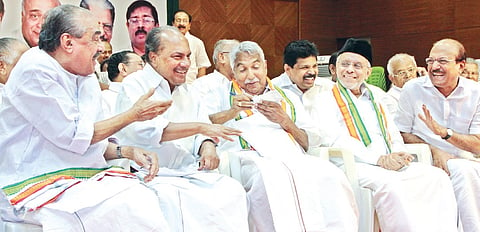

No doubt, a man clad in pure ‘white and white’ (white shirt and white dhoti) is obviously a politician. In fact, we don’t need a second thought to ascertain his ‘profession’ as ‘white and white’ has been the ‘unofficial’ uniform of politicians ever since the pre-Independence era.
Malayalis have a special penchant for white dhoti or ‘mundu’, the most common traditional garment. The manner one wears it, mundu gives a diversified look for men - from a typical ordinary Malayali man to macho ‘Neelakandan’ of Mohanlal-starrer ‘Devasuram’.

But, when ‘white dress’ became the trademark ‘uniform’ of politicians, it earned a political definition as well.
“It offers a kind of reminiscence of an era, when leaders and the public used to wear hand-spun cotton dress. Hence, politicians can easily be related to a philosophy that directly connects with the common man. Besides, white symbolises simplicity and purity, giving them a mass appeal,” said a political observer. Though all leaders, irrespective of their political affiliations, chose to wear white during earlier days, young Turks of Left parties like K Suresh Kurup and Thomas Isaac opted for coloured shirts during early 1980s. However, their penchant for white dhotis continued. Also, leaders like K B Ganesh Kumar and M K Muneer came forth to wear coloured shirts in the beginning of the new century. However, none of the UDF and LDF leaders dared to avoid dhotis, presumably in fear of losing acceptance.
Meanwhile, youngsters like Hibi Eden, who dared to wear jeans in and outside the Assembly, has a different opinion and stands for a change in the dress code of politicians. “We can see a paradigm shift among politicians, especially youngsters, in terms of dress code. We do wear jeans and pants in the Assembly as well as during our electioneering. One can wear any dress that gives comfort to him. However, it must be neat and clean. Wearing dhotis may evoke a feeling of detachment among youngsters towards us, especially on campuses. While the public have already embraced modern dress, why should politicians or legislators cling on to such older version of dress codes?” asked Hibi.
Interestingly, many of the ‘men in white’ had to struggle to keep their dress fresh, as they are forced to change their dresses at least thrice a day depending on the programmes they attend. A UDF leader in Kottayam had days when he had to change his dress six times a day. Moreover, politicians had to shell out `100 to `150 on a pair of dress, to get them washed and ironed. Even in such adversities, politicians say in unison that wearing dhotis give them an identity among the masses.
‘Unofficial’ Uniform
Though the emergence of ‘white and white’ is associated with the Independence movement - the boycotting of foreign goods for indigenously-made cotton dress - it later became an off-the-record dress code of politicians, with leaders of all parties following this ‘norm’.
DRESS CODE
“Since ‘mundu’ is traditional and natural dress code of Malayalis, politicians do not dare to switch over to jeans or pants. They might have a fear that they may lose ‘Malayalism’, if they wear pants or jeans,” said writer Paul Zacharia, adding that there was nothing wrong in politicians keeping such a dress code.