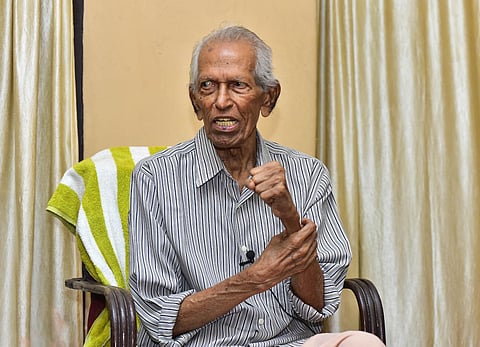

A Malayalam literary luminary in his own right, Prof M K Sanoo has been a witness to the nation’s evolution over the past nine decades. Known for his sharp observations and spare writing style, Sanoo mash, who turned 97 on October 27, is a true-blue socio-political icon admired and respected across the state.
In a candid conversation with TNIE, he speaks about communism, the Naxal movement, the Emergency, Sanatana Dharma, Pinarayi Vijayan and more
You recently returned to Maharaja’s College as a teacher. How was the experience?
They wanted me to give a lecture on literature. I talked about why I value literature more than anything. Life is multidimensional, and I believe literature is one of its most significant dimensions. We don’t know why and how, but still Vyasa, Kalidasa, Shakespeare and Sophocles remain our guiding lights. Literature is not for politics, revolution or religion. It has its own autonomy. For, the emotion it creates is different.
Has the college changed? There is no discipline now. Students are disobedient and do not respect teachers. Relations within the campus have changed, but then that’s not unique to Maharaja’s.
Did campus politics bring about this change?
It is the result of the erosion of values in campus politics. As a student during the freedom struggle, I was also part of campus politics. But that politics has changed.
There are few who have grasped Sree Narayana Guru’s vision and philosophy like you have. How relevant is Guru today?
Guru said humanity must be our religion and caste. It is something that has been part of my life. Maybe it’s a natural gift to me.
Do you think the new generation, especially those in academia, is making serious efforts to understand his teachings?
No. Even institutions started in the name of Guru are not taking efforts in that direction. We are marketing all prophets, including Guru.
Despite your deep affinity to Guru’s teachings, you were never associated with the SNDP Yogam. Why?
All my relatives had close links with the Yogam. I fell out with it. After Independence, Travancore decided to remain independent, instead of joining the Union of India. The yogam, led by R Shankar, supported the move and convened meetings to pass a resolution supporting an independent Travancore. As students, we decided to oppose it. Though my friend Rameshan volunteered to oppose the resolution, he backed out, and I had to step in.
So, you parted ways with SNDP over the issue?
No. But I remained neutral. There was no particular reason. I never had an opportunity to cooperate with it.
Do you think you could have reconciled?
No. There are no regrets.

What are your memories of the Punnapra-Vayalar agitation?
I was pursuing my studies in Thiruvananthapuram at that time. The police advised my family to move out of Alappuzha, as they would be using lethal force to quell the uprising. So, my family took a bus to Thiruvananthapuram. Later, my friend Bhargavan, who was a communist, stayed with me for a few days while in hiding. Though he surrendered, Bhargavan was subjected to torture. He later died of TB. I had good ties with workers who participated in the struggle. However, I was not part of the communist movement.
There were allegations that communist leaders left Alappuzha after instigating the workers… that K R Gouri Amma said V S Achuthanandan was not present during the struggle...
It is true that Achuthanandan was not in Alappuzha when police opened fire at protesters. I think the leaders did not anticipate the police action, and the workers were not aware of the consequences.
Was it a misguided agitation?
We do not know who guided the protesters. Communist leaders such as T V Thomas and R Sugathan were not aware of the developments, though they were arrested in connection with the agitation.
You have penned some of the most-read biographies of figures such as Narayana Guru, Changampuzha and K C Mammen Mappillai. But you haven’t written on any communist leader. Why so?
I didn’t have the required information about them. Gouri Amma wanted me to write her biography. I didn’t respond, as I was not comfortable with her behaviour. At a certain stage, she hobnobbed with the rich and neglected the poor.
Do you believe Gouri Amma got the recognition she deserved?
She didn’t. But the popular narrative that E M S Namboodiripad played a role in denying her chief ministership is factually wrong. As a well-wisher, I had lobbied for her. But some leaders, including O Bharathan, who was the parliamentary party secretary then, told me that Achuthanandan had prevented them from proposing Gouri Amma’s name.
What prompted you to contest the Assembly election as an LDF candidate from Ernakulam in 1987?
I was involved in the activities of the Purogamana Kala Sahitya Sangham, and had raised my voice against the corruption of the Congress government of that time. The LDF sought to field someone from the cultural sphere. Though I initially refused, EMS insisted that I contest. Later, when the party approached me to contest again, I told them, ‘A person can commit suicide only once.’ I felt I was losing my good qualities.
Do you now regret the decision to contest?
There are no regrets. It was an experience.
That was the first time LDF won the Ernakulam seat...
Yes. I had access to many areas in the constituency that were not open to LDF workers. That was crucial. I campaigned alone in such areas, and the local residents offered support. People from various walks of life, even INTUC workers, campaigned for me.
It’s said Sanoo mash never solicited votes for himself. Was that part of the strategy?
I never canvassed during the campaign. Instead, I focused on promoting the ideology I represented.
Was the communist party more principled back then?
Yes, things have changed. We can’t predict anything in today’s politics.
You were in the Assembly when M V Raghavan charged at T K Ramakrishnan and injured himself in the ensuing scuffle. Can you recount the incident?
There was a hullabaloo over the takeover of a cooperative society headed by Raghavan. In the commotion, Raghavan fell down. Some people kicked him. I don’t know who started the ruckus. Raghavan was subsequently hospitalised, and I visited him. However, he held a grudge against me. Later, one day, I saw him standing in front of the Assembly gate and offered him a ride in my auto-rickshaw to the MLA hostel. He refused, but I insisted, saying, ‘I am a human being.’ He eventually came around with a smile. Thereon, we enjoyed a good relationship.
You had an uneasy association with Sukumar Azhikode...
Azhikode was a lecturer at Rajagiri College, and wanted to move out from there. Justice Narendran, who was then a lawyer, became administrator of Moothakunnam College. I introduced Azhikode to Narendran, and, on my recommendation, the former was appointed principal. However, subsequently, Azhikode fell out with Narendran and unleashed a verbal tirade against him. Azhikode was on the verge of being dismissed, when I sought the help of Sahodaran Ayyappan to settle the issue.
Then?
Later, he wrote to me, saying he wanted to be the president of the Sahitya Parishad. When I tried to dissuade him, he said it was his ambition, as the post was once adorned by Ulloor [S Parameswara Iyer]. He contested, and I threw my lot with him, though there was pressure from many sides to back out. Azhikode won hands down. Afterwards, on the issue of recalling the Parishad’s nominee to the Sahitya Akademi, he switched sides. On the eve of an executive meeting, Azhikode spoke against me at a meeting of the opposing group. When I confronted him about it, he appeared nonchalant. That angered me.
Were the two of you not on speaking terms after that episode?
We did converse. When I won the Assembly election, he came to see me. But Azhikode had done much harm to me, I must say. Even at a time when my mother was bedridden, he tried to have me transferred out of Ernakulam.
Did you meet Azhikode towards his end?
Yes. He was remorseful then. He told me that it was anger that made him say many things. Azhikode could change his spots like none other for his gain. People may accord him titles such as ‘adarshadheeran’, but I had seen through them, seen what he really was. He craved power and attention.
Can you describe your friendship with Vaikom Muhammad Basheer?
I shared a close bond with Basheer. My wife was from Vaikom, and that brought us closer. He was very meticulous in his writing. Of course, Thakazhi [Sivasankara Pillai] was also very rigorous, and I respected him for that. But Basheer was more methodical. [P] Kesavadev, however, wasn’t careful, and that ruined his writing.
You are known for your unpretentious writing. What helped you stay faithful to the approach?
I cherish simple writing. I would also venture to say that it is our style that is reflected in our writing. I am a simple man.
Do you believe in God?
Of course. Had I not believed in God, I would have taken my own life (smiles).
Weren’t caste divisions at their ugliest during your student days?
In my area, there were just three communities – Ezhava, Latin Catholic, and Dheevara. There were no caste differences between them. I went to a Latin Catholic school. It was after moving to Kochi that caste divisions became more apparent. There was a ‘thampuran’ with whom I enjoyed good company. He used to share his food. Then, when he learned that I was from a lower caste, he seemed perplexed. There were many such incidents.
Caste is becoming a political hot button now. What are your thoughts on the caste census?
The country is ruled by a party whose ideology is caste politics. Caste is a reality. We have lived with it for centuries. We can’t deny that. I’m not against the caste census.
Can you explain Sanatana Dharma?
Sanatana Dharma is a concept that shows affection to all living beings. On the other hand, casteism is a part of Sanatana Dharma. Sree Narayana Guru understood that. We should be thankful to the British for the changes they introduced, such as the abolition of sati, child marriage, etc.
Are those the positives of colonialism?
Yes. Colonialism had a good side as well. The Christian missionaries’ activities had a positive impact. The British put in place the criminal and civil codes. Also, the modern education system, though it has now become commercialised.
Do you read the works of young writers?
I haven’t read any literary work in the last five or six years. Among the later crop of poets, Ayyappa Panicker was my favourite.
The language used by new writers is different... especially with the use of what is considered obscene and offensive...
I don’t like the trend. I admire O V Vijayan, but not his use of the word ‘theettam (faeces)’ in his work. It did not lend to the narrative.
Can that be viewed as part of the evolution of language?
We don’t have to include everything in society in literature.
Who are the writers who influenced you the most?
Kumaran Ashan and Thunjath Ezhuthachan. I have read their works many times. Among novelists, I like Chandu Menon, C V Raman Pillai, and Thakazhi.
Your presence at the ‘Yuvam’ event, attended by Narendra Modi, in Kochi kicked up a controversy...
I wanted to listen to his speech. Everyone said he is a good orator; I wanted to hear it for myself. It was a good speech, I liked it.
What is your take on the CPM-led Kerala government?
I think most of its policies still focus on the underprivileged. I have, of course, differences of opinion about many personalities in the government.
How about the CPM leadership?
The decay you see in society is reflected in the Left leadership, too, with the exception of Pinarayi Vijayan. I consider him a good administrator, from his early days up until now. He cares for the people.
Are you personally close with him?
Yes. Once, when he got to know I was going to attend an event in Thiruvananthapuram, he invited me over for lunch at his official residence. He sent a car to pick me up from my hotel. Someone even called my home for inputs on my favourite dishes. My wife told them that I enjoyed fish, and it was served. Pinarayi’s wife [Kamala] and daughter Veena also joined us for lunch.
Was this after he became CM?
Yes. Once, he called me at my residence. Someone else had picked up, and was told to convey to me that ‘Vijayan’ called. I was left wondering who this Vijayan was. So I returned the call, but it was engaged. Later, he called and said, ‘I am Vijayan.’ I asked, ‘Which Vijayan?’ Pat came the reply, ‘The same Vijayan who mash called a few minutes back (chuckles).’
You have lived through the Independence movement, the Emergency, and many other historically significant moments of the country. How do you view the transformation?
Even while celebrating Independence, we knew there was more to be done. We all had ideas of equality, too. We were worried about what had not been achieved. But we turned our trust to [Jawaharlal] Nehru. That turned into disillusionment. We thought he would later resign, work among people, and give power to the next generation of leaders. That was Kamaraj’s policy. But Nehru didn’t. Rather, he made others such as [Sardar Vallabhbhai] Patel resign. In a way, he was a Brahmin Chanakya.
You were at Maharaja’s College when the Emergency was declared. How were those days?
Students started protesting, and police entered the campus. In the evening, I remember reading the Indian Express edition with the headline ‘Emergency Declared’. Stepping out for a walk in the evening, I saw police beating up people. A K Gopalan reached the college, and police, too, arrived to arrest everyone. It was a scary situation.
What about the Naxalite movement... Did you know anyone from the movement?
I had acquaintances. But I was ideologically opposed to the movement. At the end of the day, you are sacrificing people. Kunnikkal Narayanan and Ajitha went to the forest and later killed two policemen. And everyone proclaimed the revolution had failed. But they truly believed in the cause.
How do you view Sangh parivar politics?
I fear that its politics will revive the caste hierarchical structure that prevailed earlier.
But isn’t the Sangh speaking about a society without caste?
Though that’s what they are saying, their activity is rooted in caste. They say the caste structure is created by God. That’s what I understood. We are moving backward.
Nowadays, there’s a trend of labelling those who go to temples as RSS sympathisers...
Yes. That’s also the case when we apply ‘kuri’ on the forehead. Kalabham [sandal paste] is offered at marriages. People believe that it implies a change of ideology (smiles).