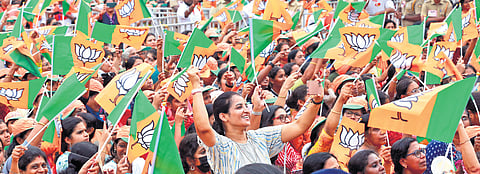

THIRUVANANTHAPURAM: The BJP, which is now busy extending Easter greetings to the Christian community, was formed on an Easter Sunday – April 6, 1980.
It was the outcome of cracks within the erstwhile Janata Party, a consolidation of opposition parties, which ousted Indira Gandhi from power in 1977.
Several sections of the Janata Party demanded that Jana Sangh leaders sever their ties with its parent organisation, the RSS, or leave the ruling coalition. Old-time ‘Jana Sanghis’ chose to quit and form the BJP.
Soon, the Kerala state committee of the BJP was formed. Like in the national scenario, here, too, the BJP’s growth has been interlinked with the RSS groundwork.
The RSS had been spearheading state-specific Hindutva movements, right from the agitation against the formation of Malappuram district in the late 1960s.
Its base gradually cemented with events such as the 1971 December Thalassery riots. The erstwhile Jana Sangh’s active participation in the anti-Emergency movement also gave it respect and space in Kerala’s mainstream political sphere.
In 1982, the RSS led the ‘Nilakkal protest’ against the then Congress-led government’s permission to build a church on the way to Pampa, the base camp of the Sabarimala hill shrine.
The same year, it organised the ‘Visala Hindu Sammelanam’ in Ernakulam, proclaiming its aim to unite the Hindu community. Notably, the decision to observe ‘Ramayana-masa Acharanam (Ramayana month observation)’ in the Malayalam month of Karkidakam – which became a popular custom across Kerala – was taken at that gathering.
“The RSS has always been working for the unity of the Hindu community,” said K V S Haridas, former editor of the Sangh mouthpiece ‘Janmabhumi’.
“It would be wrong to say the RSS engages in vote-politics. A large section of society respects the Sangh Parivar. However, the BJP has not been able to convert this factor into votes, probably because many people presume the party cannot win. But, this is a wrong perception. The BJP has 20% votes in several constituencies. A 10% spike would change the scene.”
Let’s do some number-crunching. In the 1980 general elections, of the four seats the Janata Party contested, it got a vote share of 6.7%. Jana Sangh stalwart O Rajagopal finished second in Kasaragod.
In 1984, the Sangh fielded P Kerala Varma Raja in Thiruvananthapuram Lok Sabha constituency as a ‘Hindu Munnani’ candidate. Coming third, he garnered 19.8% votes.
In 1991, the Congress, Muslim League and the BJP (‘Co-Le-B’) formed a secret pact to help each other in some constituencies. However, following the assassination of former prime minister Rajiv Gandhi, the political situation changed, and the pact fell.
Meanwhile, the BJP’s Ayodhya movement gained steam across India, and eventually culminated in the Babri Masjid demolition on December 6, 1992. The BJP got branded as a ‘Hindutva party’.
However, subsequently, with Atal Bihari Vajpayee’s tenure as prime minister (2009 to 2004), the BJP repositioned itself as a strong national alternative to the Congress. And then, after a dip in 2009, came the ‘Modi wave’ in 2014.
Today, the BJP has a higher vote share than the Muslim League and the CPI, with the party bagging 12.93% of votes in the 2019 general election.
In the case of assembly elections, the BJP’s vote share has grown from 2.75% in 1982 to 11.3 in 2021. The biggest upswing came in 2016, when the party’s vote share rose from 6.03% to 10.53%. The party also opened its account for the first time in the state assembly as Rajagopal romped home with 47.46% votes.
In the 2021 assembly elections, the BJP lost its sole seat. However, it came second in seven constituencies – Manjeshwar, Kasaragod, Attingal, Nemom, Kazhakootam, Vattiyoorkavu and Palakkad. And its vote share rose to 11.3%.
Though the BJP’s attempts to stitch together a strong third front in the state have failed over the past couple of decades, the party is upbeat about having attracted a star face such as Suresh Gopi, and also Congress deserters such as Anil Antony and Padmaja Venugopal – children of former Congress chief ministers A K Antony and K Karunakaran, respectively.
Another big catch has been seven-time MLA P C George, who recently merged his party, Kerala Janapaksham, with the BJP.
“The BJP has been virtually alone all these years. Yet, it maintained a steady growth in vote share,” Haridas noted. “The NDA was formed much later. The BDJS came only in 2016. Had the BDJS performed better, more allies from the UDF would have joined the NDA.”
Besides betting on the ‘Modi ki Guarantee’ poll plank, this year, the BJP hopes to attract a solid chunk of Christian votes in key constituencies such as Thrissur and Pathanamthitta. Will this Easter be a ‘happy’ one for the party’s state unit?
