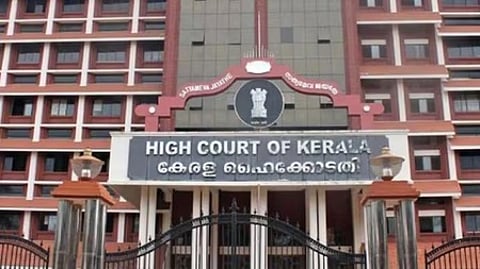

KOCHI: The Kerala High Court on Wednesday stayed the Kasaragod sessions court's order discharging BJP state president K. Surendran in connection with the Manjeshwar election bribery case.
Justice K. Babu issued the order following an appeal filed by the state government seeking to quash the acquittal of Surendran.
The court has also issued notice to Surendran.
According to the prosecution, Surendran and others allegedly bribed Bahujan Samaj Party (BSP) candidate K. Sundara with Rs 2.5 lakh and a smartphone to withdraw his candidacy in the 2021 Assembly elections. The police further alleged that the accused threatened K. Sundara, who belongs to the Scheduled Caste community, to withdraw his election nomination papers.
P. Narayanan, Additional Public Prosecutor, stated that the discharge of the accused for the offence charged against him is "illegal and against the materials produced by the prosecution." He argued that there is "sufficient and overwhelming evidence/material produced by the prosecution to place the accused on trial for such offences."
Narayanan contended that the sessions court ought not to have found that there was an "inordinate delay" in recording Sundara's statement, as he was questioned just three days after the complaint.
The state government also asserted that the sessions court had exceeded its jurisdiction under Section 227 of the Code of Criminal Procedure (CrPC) by holding a mini-trial based solely on materials that were not put to proof. The jurisdiction of the court under Section 227 is to determine whether there are sufficient grounds for proceeding against the accused.
"Consideration of the existence of sufficient grounds does not mean that the court can evaluate the materials produced by the police as if it is conducting the trial of the accused," the government argued.
The sessions court relied on two statements given by Sundara and identified certain inconsistencies, concluding that Sundara's statement could not be believed. The state government claimed that this approach is "illegal and impermissible under the law," emphasising that it is only at the trial stage that the court can evaluate the material and determine whether Sundara's statement is credible.
Furthermore, during the trial, the witness will have an opportunity to explain any contradictions, omissions, or inconsistencies, which was not permitted in this case.
The sessions court's finding that Sundara accepted the alleged bribe voluntarily and with free consent was described as "wrong and against the facts," contradicting the ethos, purpose, and object behind the Scheduled Castes and the Scheduled Tribes (Prevention of Atrocities) Act, as submitted by the state government.
