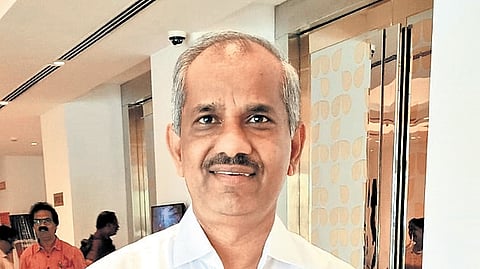

With the rise in extreme weather events in Kerala, accurate weather predictions have become essential. The tragic Wayanad landslide underscores the importance of an urgent need for enhanced weather prediction capabilities. In a conversation with TNIE’s Unnikrishnan S, Ministry of Earth Sciences (MoES) secretary M Ravichandran, who is leading ‘Mission Mausam’ to address these challenges, discussed various strategies to improve accuracy. Excerpts
How do you think we can improve the accuracy of weather predictions?
As of now, we lack a mechanism to predict weather even within a 12-km radius accurately. We can provide only a general picture. To improve this, we need better models and more observations. For example, Thiruvananthapuram required just one observation point earlier. However, we need at least 50 such spots now due to urban growth. We need more data and a better understanding of local weather. Until we do this, accurate predictions will be difficult.
What are the plans to augment infrastructure for weather predictions?
We recently launched Mission Maus-am. The initiative aims to gradually improve our observatory system by adding more radars, Automatic Weather Stations (AWS), and enhancing our modelling capabilities. It’s a five-year plan, and we’ve received special approval for Rs 2,000 crore for the first two years. There are four key components to improving predictions: more observations, better understanding, enhanced modelling, and effective dissemination of information. Observations account for 50% of accurate predictions, while the other three components share the remaining 50%.
How many new observation systems will be established in Kerala?
We haven’t specified the number of systems for each state yet. But Kerala will surely have a big share as it is the place of monsoon onset. The region experiences a lot of variability, and its fragile ecosystem makes weather predictions challenging. With both hilly terrain and a coastline, we deal with land and sea breezes, adding to the complexity. The rich water bodies in the area also complicate weather predictions. If we achieve at least 60% accuracy in weather predictions in Kerala given the state’s complex climatic conditions, it would be like achieving 100% accuracy across India.
Is the shortage of manpower a concern for increasing observations?
Yes, we need to increase manpower. We should also think about privatising some of the observation systems to help address this issue.
How can we privatise weather observations?
We can outsource the installation of AWS to private companies. As long as they install the systems and provide accurate data, I’m willing to pay for it.
Have you adopted this approach?
Yes, we’ve implemented what we call the data model. The agriculture ministry is following this as well. Any vendor can participate, and we can assure them of a contract for a certain period, like five years. We can also utilise data from NGOs.
There was a lot of blame after the Wayanad landslide regarding inaccurate or no warnings...
The situation in Wayanad was complex. It involved a fragile ecosystem as well as continuous rainfall over 4-5 days. It was not just about a single day’s forecast. A variety of factors made the weather predictions challenging.
What measures are being taken for coastal areas, given that 90% of the coastline is fragile?
We are seeing more extreme events, including Kallakadal (swell surges). We need to adopt new strategies to address coastal erosion. Marine spatial planning should be approached similarly to town planning to better manage these challenges.
Some areas such as Wayanad are prone to seismic activities, but there aren’t many seismic stations...
We are planning to increase the number of seismometers in high-density areas. Our goal is to detect any earthquake of 2 magnitude within two minutes. Currently, we can achieve this in three minutes for earthquakes of 3 magnitude.
