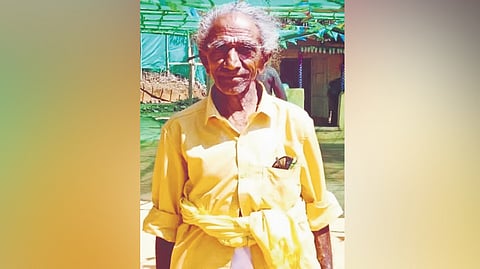

IDUKKI: Long before Munnar became synonymous with tea, two Muthuvan tribesmen — Kanan and Devan — guided British planters through the hills, lending their names to the Kanan Devan range.
Nearly a century later, another Muthuvan by the name Krishnan played a pivotal role in shaping the legacy of the region — by protecting its forests.
Fondly called Krishnan Thatha, he was a trusted guide for forest officials, leading them through dense forests to remote tribal hamlets inside what is now Eravikulam National Park.
On Thursday morning, Krishnan died of age-related illness. He was 95.
Krishnan’s deep knowledge of the terrain proved invaluable during the Eravikulam park’s establishment in 1978, making him a quiet yet enduring face of Kerala’s conservation story.
Back in the 1970s, when poaching and sandalwood smuggling plagued the Eravikulam and Marayur forest ranges, Krishnan became the forest department’s most reliable ally.
Runners used the treacherous Eravikulam-Edamalakkudy route to move sandalwood to areas such as Mankulam and Anakkulam, but Krishnan would tip off officials and even help track down culprits hiding in forest caves
“Whenever Krishnan received alerts, he would immediately inform the department and help capture smugglers. He knew every inch of the terrain, including the caves that poachers used to escape,” recalled a forest official. Krishnan’s connection to the wild was rooted in commitment. A strong believer in conservation, he worked tirelessly to protect the fragile ecology of Eravikulam, including the rare Neelakurinji, which blooms once every 12 years.
Not only did he guard the bloom from disturbances, but he also educated fellow Muthuvans on the importance of preserving the endemic shrub species.

“Krishnan’s efforts at Neelakurinji conservation are also remarkable. Besides protecting the species, he also spread awareness among his tribal folk about its conservation,” the official said.
His role as a temporary forest watcher from 1978 laid the foundations for broader tribal participation in conservation, transforming how the park engaged with its native communities. Inspired by his dedication, more Muthuvans — who once kept their distance from outsiders — joined hands with the department in conservation efforts.
This cultural shift led to the forest department employing more tribal people from Edamalakkudy and Lakkam Kudi as watchers. “The department has employed a total of 34 persons from Lakkam Kudi as forest watchers in the sanctuary. This includes five tribal women as well,” said Harrison Sasi, a forester at Eravikulam National Park.
“All these changes were carried out because of Krishnan. Eight tribesmen, all his relatives, were appointed watchers at the park in 2006,” he said.
“The location for the key camp sheds, where park staff stay, was identified by Krishnan. The facilities required locations close to sources of water, that were at low risk of landslide and were sheltered from winds — and Poovar and Varattakkulam meet all those criteria,” said Arumugam, a tribal forest watcher. Offering condolences on his official Facebook account, Forest Minister A K Saseendran acknowledged Krishnan’s “lifelong commitment to and extraordinary efforts in protecting our forests.”