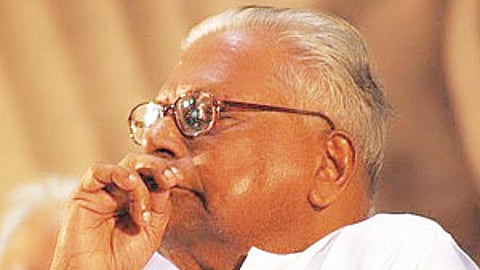

A hundred years ago, when V S Achuthanandan was born, the world—especially the colonies—was reeling under severe famine and the struggle against colonial rule. The Great Depression had made life miserable for the working class and peasants. As a young boy, he experienced the harsh realities of poverty, as his family struggled to make ends meet.
Caste discrimination was rampant. Achuthanandan, even as a schoolboy, had to physically resist the injustices he faced. He often recalled how he had to carry a weapon to defend himself and other backward community students from the agents of landlords who tried to prevent them from attending school.
Later, he became a worker in a factory where he found himself in the middle of another struggle—this time against exploitative managers who demanded hard labour without fair wages. It was during this period that the Communist Party began to emerge as a force in northern Travancore. Under the leadership of P Krishna Pillai, trade unions were formed and the coir workers’ unions of the time were radicalised. Many factory strikes were led by a young and determined VS.
In the mid-1940s, the Vayalar and Punnapra uprisings against C P Ramaswami Iyer’s rule erupted, and VS was one of the key leaders of these movements. He endured severe police torture at the Poonjar police station and was bayoneted in the foot during one such crackdown.
VS rose as a resolute leader within the Communist Party. His was a fierce presence in internal party struggles. In 1964, he was demoted to the Alappuzha district committee. However, he quickly corrected his course and re-emerged as a central figure in the party.
In the 1980s, during another round of organisational strife in the CPI(M), VS led the official party. As a leader of the CPI(M)-affiliated Students Federation of India at the time, I had to stand against the purging spree led by VS in the mid-80s when M V Raghavan and his colleagues were expelled from the party. When the CMP was formed, VS opposed it using every political tool at his disposal—but never on personal grounds. In the mid-1990s, he faced significant challenges within the CPI(M). Though he was due for chief ministership, he was defeated in Mararikulam. Yet, like a phoenix, he returned — reinvented and renewed.
From 1996 onward, a new Achuthanandan emerged in Kerala politics. He set forth a fresh agenda—waging war against corruption, defending the fragile ecology of the Western Ghats, and fighting for women’s rights. The last three decades of his political life reflected a transformation rarely seen. For many leaders, the later years mark the sunset of their careers. But for VS, the sun never set.
Even as he approached 100, he remained unwavering. He never compromised with those he saw as political adversaries. Yet, his fights were never personal—always political. That was the essence of V S Achuthanandan—a relentless fighter who never stopped standing up for what he believed in.
