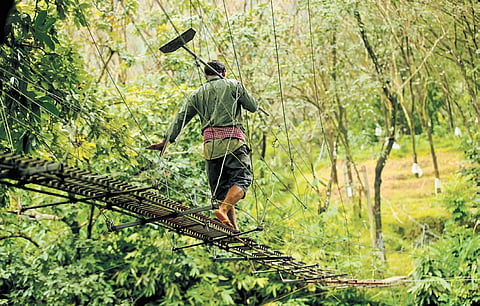

IDUKKI: At a time when the metro rails and water metros have become the face of modern transport in cities, a quiet village in Idukki is crafting its own path to connectivity. At Malayinchi, in Udumbannoor, residents don’t wait for government interventions or sanctioned infrastructure projects. Instead, they build hanging suspension bridges with their own hands-an enduring solution to the seasonal river that cuts through their lives.
Every year, the relentless monsoon rains arrive with force, washing away or weakening the makeshift bridges. And every year, the villagers come together, pooling their limited resources to erect new ones.
They gather any materials they can get -bamboo, steel straps, tree trunks, and even PVC pipes to build the bridges.”For us, it’s part of life,” says Sasi, a lifelong resident. “When a bridge gets damaged, we don’t wait for help. We gather as a community and rebuild it for the next season. It’s something our fathers and grandfathers have always done,” he said.
Once, bamboo was abundant and the mainstay of these structures. But with dwindling availability and growing safety concerns, the villagers now rely on stronger materials.
Today, Malayinchi has at least five such suspension bridges swaying gently over the Chelakkadu, a tributary of the Veloor river. Outsiders may hesitate to step on the narrow walkways, but children here skip across them with ease. Pointing to the bridge in front of his house, Sasi explains how it was built.

“This one was made using iron, tree trunks, and steel straps. We pooled around Rs 40,000, and to save costs, the welders and carpenters from our own village took charge. Everyone contributed in some way.”
Among them was 65-year-old Appachan, a carpenter, who led the team that built the suspension crossing near Sasi’s house. “For me, it’s not just about building a bridge,” he says with a smile. “It’s about keeping our community connected,” he said.
Appachan has also added something special for the visitors who have begun to discover Malayinchi’s rustic charm — two giant swings hanging from a riverside tree. “Travellers who stop here can enjoy the view, while we villagers use it as a place to sit, talk, and rest. It’s simple, but it brings joy,” he said.
The panchayat, however, admits its limitations. “Constructing large bridges everywhere is not possible with our limited funds, especially when the hamlets are scattered and many families have migrated to cities. They return only to look after their farmland,” said an official. Already, there are two concrete bridges in Malayinchi, but families in the interior areas still depend on the handmade suspension crossings.