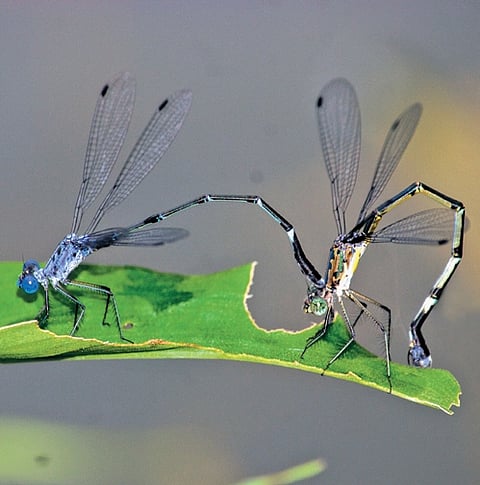

KOCHI: A three-day survey of odonates, organised jointly by the Society for Odonate Studies and the state forest department, has documented 121 species of dragonflies and damselflies in the Thiruvananthapuram Wildlife Division. The survey conducted from September 12 to 14 marks a major milestone in regional biodiversity studies, with five species recorded for the first time in the division’s checklist.
A team of 25 volunteers, guided by leading odonate experts Sujith V Gopalan, Vivek Chandran, Muhamed Sherif, Renjith Jacob Mathews, and Reji Chandran carried out the survey across 10 strategically chosen camps and adjoining habitats. The camps were selected along an altitudinal gradient to encompass maximum habitat diversity and microhabitats within the division.
The survey recorded 73 species of dragonflies and 48 species of damselflies. Among them, five species were reported as new additions to the division’s odonate checklist. The newly recorded species are Merogomphus aryanadensis (Dainty Longleg), Protosticta sanguinithorax (Crimson Reedtail), Anax indicus (Lesser Green Emperor), Macromia bellicose (Militant Torrent Hawk), and Lestes dorothea (Forest Spreadwing).
The dainty longleg and crimson reedtail were recorded during a study conducted last year. The Dainty longleg is a big dragonfly found in forest areas. It has long legs and lives of the leaves of trees. The crimpson reedtail have crimson colour on its chest.
The Lestes dorothea or forest spreadwing have wings that spread like an umbrella. The Anax indicus are big dragon flies that live on the banks of streams and are seen flying over water bodies swiftly. The Macromia bellocose are seen hanging f rom vegetation in forest areas. The Merogomphus aryanadensis was first recorded in Aryanad area and hence have been named after the place.

Some survey camps, like Anchunazhikathode documented over 46 species and sites like Pulininnakala and the nearby area documented 80 plus species, reflecting the pristine quality of the region’s ecosystems.
The survey recorded a good population of stream-dwelling torrent darts such as Euphaea fraseri (Malabar torrent dart) and Euphaea cardinalis (Travancore torrent dart), and Myristica swamp specialists like Calocypha laidlawi (Myristica sapphire), a rare and beautiful damselfly of this habitat. The torrent darts are indicators of good stream health, said Sujith V Gopalan.
Shade-loving damselflies such as Protosticta ponmudiensis (Travancore Reedtail) and the recently described Protosticta armageddonia (Armageddon Reedtail) add to the list along with Bambootail species from the genus Esme and Caconeura.
Other charismatic regional endemics, including Epithemis mariae, Gomphidia kodaguensis, as well as species of Epophthalmia, Macromia, and Idionyx were also observed. The high number of endemic odonate species recorded during the survey underscores the ecological richness and pristine nature of the region’s habitats. Odonates, being highly sensitive to environmental change, serve as critical indicators of ecosystem health, reflecting the quality of water systems and forest habitats, he said.
The survey was inaugurated by Conservator of Forests N Syam Mohanlal and flagged off by Thiruvananthapuram wildlife warden Vinod S V.