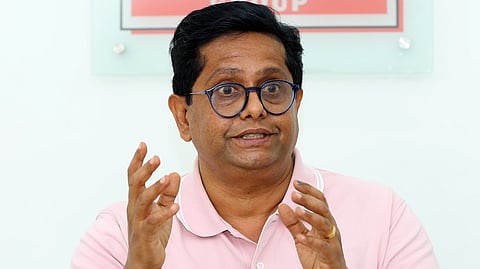

With the landmark success of Drishyam (2013), Jeethu Joseph emerged as a pan-Indian director. The film became a milestone for the thriller genre, spawning multiple remakes across Indian and international languages. Coming from a planter family, with no background in creative pursuits, he has since made his mark by exploring a range of genres in his filmmaking journey.
TNIE catches up with one of Indian cinema’s most bankable writer-directors as he speaks about his family, career, and his views on films and society.
Excerpts
You have explored many genres, but it always comes back to ‘Drishyam’ and the franchise that stands out. Do you feel a burden because of the expectations, especially as ‘Drishyam 3’ is ready to hit the screens?
When a prequel or sequel becomes a big hit, expectations naturally follow. But I don’t see that as a burden or something to fear. I just try to move forward in my own way. The ‘Drishyam’ franchise, for me, is essentially a family drama. People tag it as a thriller, but whether it’s ‘Drishyam 1, 2 or 3’, I still see it as a family drama. Once a crime element came into play in the first film, it automatically got labelled as a thriller. Yes, people expect a hit, but that doesn’t intimidate me.
Take ‘Drishyam 1 and 2’: while audiences focus on the twists and Georgekutty’s brilliance, there’s a deeply emotional family story at its core. Georgekutty isn’t some exceptionally clever man; he’s an ordinary person placed in extraordinary circumstances. So I don’t carry the burden of expectations. Each film is different... the second is not like the first and the third is not like the second. Ultimately, it’s about the life of Georgekutty and his family and how it changes over time.
How did you arrive at the idea of ‘Drishyam’?
The idea for the film actually came from a real-life incident involving two families approaching the police with a conflict. What intrigued me was that both families had valid points... you wouldn’t know whom to side with. But once a star like Mohanlal came on board, the narrative evolved naturally and the focus shifted more towards Georgekutty’s intelligence and the twists that followed.
Your father was an MLA. Did you follow politics, and has it influenced you?
My father was an MLA from Muvattupuzha, but he wasn’t keen on his children entering films. His approach to politics often involved using personal resources — our family did feel the strain at times. People used to call him “Kochettan”, and there was a perception that he was prosperous and could foot the bill. So he often ended up helping others financially. In college, some students even tried to push me into student politics, but my father advised me against it. I agreed... I was never really interested. Politics requires a certain temperament. You have to constantly engage with people, even when you don’t feel like it. I don’t think I’m suited for that. I believe in being straightforward and standing by what I say (smiles).
It’s said your mother was a strong influence in your life…
Yes, she has been a powerful influence. She’s 86 now and a cancer survivor — an incredibly strong woman who has always stood by all of us, especially during difficult times. There was a phase when I struggled to get my first film off the ground. Even after a year and a half, nothing was moving, and I felt quite dejected. It was she who gave me the confidence to keep going. I remember, during the early stages of ‘Detective’, when I was particularly low, she told me, “Don’t worry, we’ll make this film — even if we have to sell something.” Eventually, it didn’t come to that as a producer came forward. But that reassurance meant everything to me. Even today, whenever I’m in a crisis, talking to her has a calming effect. She brings clarity and renews my confidence.
How did you get into filmmaking? When did you decide this was your path?
I stayed at my cousin’s house during my Pre-Degree days. He had a close friend — both of them were passionate about films. They would often skip classes to watch movies. Gradually, I got drawn into their discussions and my fascination with cinema began to grow. I still remember watching ‘No. 20 Madras Mail’... as the train moves through places like Thiruvananthapuram, Kollam and Kottayam, they noticed that the engine number changed in between. They pointed out that it was a “continuity error”. That made me wonder... what is continuity? Without even realising it, I was slowly entering the world of cinema. After completing Pre-Degree, we went our separate ways. I wanted to join the Pune Film Institute, but that didn’t work out. Someone then advised me to assist directors and gain practical experience instead.
As a filmmaker, which movie helped you to build your career?
Definitely, ‘Mummy and Me’. There were no big stars but the movie was successful. Producers then started approaching me. Thereafter, I made ‘My Boss’, ‘Memories’, ‘Drishyam’, etc. The back-to-back successes of ‘Memories’ and ‘Drishyam’ helped establish me as a director and people started identifying me as a thriller director. Basically, I am not a thriller director. I select subjects based on characterisation that connects with our daily life. I am a storyteller, and it is the subject that attracts me. I want stories and characters the audience can relate to.
What changes have you observed in the audience’s taste over a period of time since the release of ‘Drishyam 1’?
My observation is that if there’s a short lag in storytelling, people switch to their mobile phones. The new generation gets distracted by even a small deviation. You can see people checking their mobile phones in the theatre. Whether or not to adapt to the changed taste is a decision for the filmmaker to make. If I ignore the changing taste, my films will not survive in theatres.
Have you factored that in while making ‘Drishyam 3’?
While making ‘Drishyam’, my focus was on family emotions, the organic growth of the family, what can happen to the family after so many years, and how I can tell the story in an interesting way. I can think about ‘Drishyam’ only in an established way. I prefer to approach a character honestly.

Is there a trend of making movies for OTT platforms?
Yes. Movies like ‘Bharatanatyam’ did not survive in cinemas despite a positive response. Many people told me they would watch it on an OTT platform. A family has to spend at least Rs 1,200 to watch a movie in a theatre. So they select movies accordingly. We have to experience the theatre feel of movies like ‘Lokah’. So people become choosy.
What were the first visuals that came to you when you began thinking about ‘Drishyam 2’?
Everything about ‘Drishyam’ is rooted in the family. The story has always revolved around what happens to them. I began by asking myself: what might have changed in their lives after all these years? It had been eight years since the incident, so naturally the children would have grown up. I was also curious about how society would perceive the family now. There’s a moment in the film involving an autorickshaw driver who casually remarks, “Maybe that man has come to see the mother.” It reflects how, over time, even a society that once stood by the family begins to think differently. People start weaving their own stories and interpretations. So, whenever I think about ‘Drishyam’, it is always through the lens of the family—what they have been through and how they are coping. By the end of ‘Drishyam 2’, the family survives a major tragedy. That naturally led me to the next question while thinking about ‘Drishyam 3’: what comes next? What new challenges will they have to face?
Has there been any thought of writing the story for ‘Drishyam’ in a fresh perspective by collaborating with another writer?
Many people had enquired about the possibility of a second sequel. But I preferred to remain non-committal. In 2015, I got information that some people had suggested a second part for the Hindi version. Then I started thinking seriously about the sequel because there was a clause for prequel and sequel in the movie. Many people have shared their ideas about the ‘Drishyam’ sequel. I delete such mails without reading them because it may influence my plot.
We often hear about ‘Drishyam-model crime’ these days. As the director of the film, how do you look at it?
I don’t think much about it. Murders like the one featured in the movie had happened way before the film had even been thought about. Who in their right mind would go and confess their crime before the police? That is not in human nature. People will try to conceal their crime. Of course, there might be a few courageous enough to confess their crime. But such people are rare. So, there is no such thing as ‘Dhrishyam-model murder’. The tag was coined because the film became popular.
But don’t you think that movies influence people?
Yes, films do influence people and in a big way. I too have done something after being influenced by a movie, during my college days. Bruce Willis’ ‘Die Hard 2’ was playing at Shenoy’s Theatre. There’s a scene in which Willis’ character smokes a cigarette. I was so influenced by the way he smoked that after the movie ended I went to a nearby shop, bought a cigarette, and tried it out like the Hollywood actor. I, a person who never smoked, did that! So, yes, films do influence people.
As a filmmaker, are you conscious of the huge responsibility that rests on your shoulders?
Yes, of course. I make a conscious effort to avoid violence in my movies. However, sometimes, when the film’s storyline demands it, I have to make an exception. The making of the film ‘Neru’ was one where I shot a rape scene for the first time in my life. The tension and the stress that I underwent were unimaginable. I took a lot of time to shoot the scene. I wanted the scene to sit well, even for a family audience. Of course, there are cases where brutality becomes a need as per the story. However, in such cases, you do the needful with discretion without losing the essence of the story.
Don’t you think it would have been good if ‘Drishyam 2’ had shown parents reassuring their daughter that it was not her fault such an incident happened?
Yes. I realise that now. However, people in law enforcement raised apprehensions the film was promoting crime by showcasing how the parents stood with their daughter and covered up the murder. I was informed about such whispers by Justice K T Thomas. However, he said he stood by what was shown in the film. To quote him, “If anyone like that guy comes into your home, he needs to be eliminated.” Then there were people asking why they couldn’t go to the police. Didn’t the murder happen in self-defence? This was the reason why I portrayed the youth as the son of a police inspector general. ‘Drishyam’ is a film of human emotions. For me, ‘Drishyam’ is a family drama.
You once mentioned that the most tension you experienced was while making Pranav Mohanlal’s debut film...
The tension was mainly because, while launching him, there was always the fear of something going wrong. I kept sharing these concerns with Mohanlal, and he too admitted that he started feeling tense. Pranav is someone who fully commits to a project. He does one film a year and then takes time off—that’s his choice.
Since 2022, you’ve done seven movies. Are you a workaholic?
Well, it happened because of two things, to be frank. After ‘Drishyam’, a lot of people approached me with an advance and sought to work with me. So, I had the commitment to finish those. I could have given the money back and wriggled myself out of a few. But I thought that wasn’t the right way. Generally speaking, I kept my word, because there were many who waited for me. I’ve made a decision not to take on so many projects because the workload and stress that come with it are too much.
How do you look at new experiments happening in Malayalam cinema?
A film like ‘Lokah’ cannot be made in Hindi with the same budget. We work within limitations and that’s what surprises others... we produce strong output despite limited budgets through experimentation. Because of this, many Hindi producers have approached me to make Malayalam films. At the end of the day, it’s a business too.
Often, watching remakes of Malayalam films can be disappointing. How do you evaluate ‘Drishyam’ remakes?
They work for their audience in their contexts. Each version should be presented in its own way. We don’t need to judge them. If the audience there accepts it, that’s what matters.
It was reported that the script of ‘Drishyam’ was first presented to Mammootty. Why didn’t that project happen?
He didn’t have the dates at the time. He said he would only be available after two years, and he was very open about it.
You are into production too…
We have to give opportunities to new directors and filmmakers. We are supporting them. We are listening to scripts. My daughter heads the production. We have a team that listens to stories. We get a detailed synopsis. We need to understand what the story is about. What we aim to do is complete the film within the budget. The problem with our industry is the budget. Most of the time, we cannot finish the project on schedule and within the budget. So we are planning to bring in a disciplined system.
You mentioned earlier that the Gulf market is crucial for the Malayalam film industry. If the current issues there persist, will it affect the Industry?
Of course. The Gulf market makes a significant contribution to our collection. It is not just because of war-related concerns or missile attacks. There are also salary cuts and financial pressures there. Naturally, families will start reducing non-essential spending, and cinema outings are among the first things people cut. A family that watches a film every week may decide to go once a month. It has a ripple effect.
Some people say certain Malayalam films resemble foreign cinema. How do you react to that?
I’ve openly admitted that ‘My Boss’ was inspired by another film, incorporating our nativity. Speaking about my other films, where these accusations have come, many people can arrive at similar ideas independently.
That happens often in cinema. I had written the script for ‘Drishyam’ long before the actual release and had originally written it for my associate. In that version, the lead character was a C-class theatre operator. Later, after my film’s release, someone sent me a foreign film on a CD and said it had similarities. When I watched it, I understood why they said so. But similar ideas do not necessarily mean copying. Human emotions and dramatic structures can overlap. There are many films across the world with comparable themes. But again, such similarities can happen coincidentally. Sometimes, the central idea may feel familiar, but the treatment is entirely different.
There has been increasing discussion around political correctness. Have you ever censored yourself because of that?
Frankly, I still don’t fully understand what political correctness means in every context. Sometimes, I ask younger people about it. From what I understand, the intention behind it is good. But at times, it can be overextended, even to trivial matters. That is my only concern. I have no objection to that. My only doubt is in the way it is applied sometimes.
You are someone who does not give out the typical film personality vibe. Is that intentional?
That probably comes from my father. Though he was an MLA, he was also a hardworking farmer and a rubber planter. People often tell me that they feel more comfortable with me once they know I’m Kochettan’s son. He never gave us direct advice but showed us how to live simply through his actions.
People are already asking about ‘Drishyam 4’. Is that happening?
(Laughs out) Let us finish ‘Drishyam 3’ first. Everywhere I go, people ask me this. So yes, people are eager, but first, let us complete part three.
TNIE team: Cithara Paul, Rajesh Ravi, Vignesh Madhu, Vivek Santhosh, Anna Jose, Harikrishna B T P Sooraj (photos) Pranav V P (video)