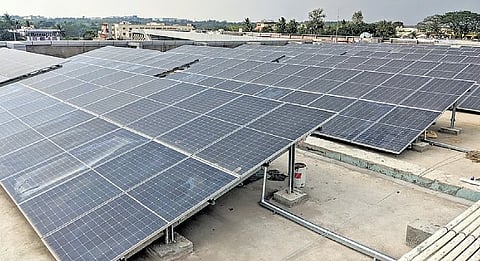

KOZHIKODE: Summer evenings for Shyam Prasad meant inspecting every room at his house in Kozhikode’s Malaparamba and reminding his family to switch off the lights, fans and other appliances as power bills climbed with rising temperatures.
This year, however, Shyam is relaxed. Ever since he installed a 3-kW rooftop solar unit in March, he has not had to worry about bills soaring due to the sweltering heat.
The story is similar in thousands of households across the state. As Kerala’s power consumption shatters records this summer—the state on Saturday consumed 117.1555 million units of power and peak load touched to its highest at 6,033MW—there has been accelerated interest in rooftop solar units, especially of 3kW and 5kW units, among homeowners.
Since January 2026, there has been a steep rise in demand for the units and around 40,000 consumers are awaiting installation or conversion (of applications). Officials note that the bulk of the applications were received in March and April.
Kerala’s solar expansion has been rapid over the past year, with over 1.08 lakh rooftop solar plants installed between April and December 2025, pushing the total to over 3.6 lakh installations statewide. In comparison, the previous fiscal saw around 98,636 additions.
The accelerated pace is widely linked to the PM Surya Ghar Muft Bijli Yojana, which has made solar adoption more financially viable for households.
“The shift is helping both consumers and the power sector,” said Naseef Irshad, assistant engineer at KSEB’s 110kV GIS substation at Gandhi Road in Kozhikode.
Kerala’s total solar capacity higher than hydel
“Rooftop solar units let households generate electricity during peak daytime demand, reducing stress on the grid. It also helps consumers significantly cut down electricity expenses over time.,” he said. Distributed solar generation helps manage peak load conditions, especially during months of extreme summer when demand surges sharply.
Irshad also said integrating large volumes of solar energy requires careful grid management. “We are seeing a rapid rise in daytime generation, which brings challenges such as voltage variations and load balancing. Strengthening infrastructure is essential to accommodate this growth,” he said.
In Kerala, the KSEB remains the nodal agency overseeing approvals and grid integration, even as multiple private companies handle on-ground installation. Under the subsidy framework, consumers can avail financial support of up to `78,000 for systems up to 3 kW. This has played a key role in boosting adoption.
However, the transition is not without challenges. The surge in daytime solar generation is placing stress on the state’s transmission and distribution infrastructure, leading to issues such as voltage fluctuations in certain areas. Additionally, while solar users benefit from reduced bills during the day, the grid must still supply power at night, often at higher costs.
Still, officials highlight Kerala’s strong performance in implementing rooftop solar initiatives, with a conversion rate of over 60% from application to installation.
Kerala’s total solar power capacity is around 2,228.765 MW currently, surpassing the installed capacity of hydroelectric projects, which stood at 2,096.36 MW as of March 2024.
On average, nearly 12,000 new solar plants are being added every month, contributing around 60 MW of additional capacity. The current systems are estimated to meet around 22% of daytime electricity demand.
The state will not resort to load shedding, Power Minister K Krishnankutty has said. “The government has made adequate arrangements for uninterrupted supply.”
