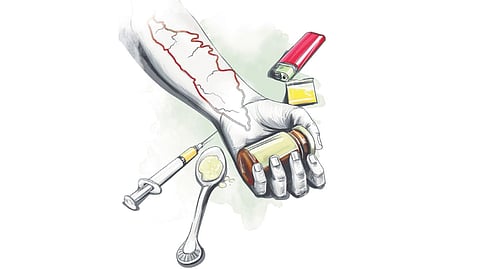

KOCHI: A worrying shift is under way in Kerala’s drug landscape. Law enforcement agencies in Ernakulam are increasingly detecting a gradual transition from ganja to harder narcotics like heroin among migrant worker networks, triggering enhanced surveillance.
On most days, routine inspections by the police, excise and Railway Protection Force (RPF) lead to seizure of drugs from migrant workers. For years, these workers were largely used as carriers in the ganja pipeline, transporting consignments from states such as Odisha and West Bengal into Kerala.
However, excise officials in Ernakulam say there is now a noticeable rise in heroin-linked cases, particularly among workers from northeastern states.
“We have formed a special team to track the network, its supply chains and distribution methods,” a senior excise officer said. “Efforts are on to dismantle such operations with coordinated intelligence inputs.”
In 2024, around 103 migrant workers were booked in Kochi city under the NDPS (Narcotic Drugs and Psychotropic Substances) Act. The number rose to 176 in 2025. While over 80% of the cases involve ganja, the growing presence of heroin has raised red flags.
This year, multiple heroin seizures ahead of the elections underscored the shift. On Monday, excise officials recovered 150g of heroin from a migrant worker in Angamaly, 52g from another in Aluva, and 6.6g from a third individual in Kothamangalam.
Those arrested were reportedly natives of Assam and other northeastern states, pointing to a possible geographical pattern.
The officials believe sustained enforcement against bulk ganja transport is pushing traffickers toward high-value, low-volume drugs that are easier to conceal and move.
Heroin is far more portable than ganja. This makes detection harder and drives up margins,” an officer noted.
Railway routes remain a critical channel. As per RPF intelligence units, traffickers often abandon bags containing ganja under train seats and later share location details with operatives in Kerala.
“There are usually handlers onboard to monitor the consignment and alert the network if enforcement teams intervene,” an RPF officer said.
“We have intercepted several such attempts. However, the shift to hard drugs is a more serious threat.” Ground-level inputs suggest financial incentives are also playing a key role in this transition. Migrant workers familiar with the network say peddlers are offering up to 20% as commissions to those who can build a steady customer base for heroin.
“The profits are higher, so it is being pushed into worker hubs,” said Debasis, a migrant worker familiar with cartel operations in Ernakulam. “There is still fear of overdose and its consequences. Some recent incidents have made people cautious. But if that fear fades, heroin may spread quickly.’
With enforcement tightening and networks adapting, agencies warn the challenge is entering a more complex phase, one where the stakes are higher, the substance deadlier, and the networks harder to track.
Law enforcement agencies in Ernakulam are increasingly detecting a gradual transition from ganja to harder narcotics like heroin among migrant worker networks
In 2024, around 103 migrant workers were booked in Kochi city under the NDPS (Narcotic Drugs and Psychotropic Substances) Act. The number rose to 176 in 2025
Migrant workers familiar with the network say peddlers are offering up to 20% as commissions to those who can build a steady customer base for heroin
