
THIRUVANANTHAPURAM: In most Hindu temples across Kerala, a ghee lamp (neivilakku) is a personal offering, performed as a ritual within the sanctum sanctorum.
At a few temples, tradition goes a step further, with every lamp inside the sanctum lit only on ghee. But the Sabarimala Temple is a class apart. Here, every lamp, inside the sanctum and outside, burns on ghee alone. The reason is simple: the temple receives such a bounty of ghee each season that it has become the very fuel of its illumination.
The Travancore Devaswom Board (TDB) which manages the temple is considering a modernisation plan for the collection and management of the surplus ghee. It includes a proposal to replace the present iron-made storage tanks with stainless steel ones fitted with an index meter and see-through facility, said board president K Jayakumar.
The board receives close to 1,000 litres of ghee every day during the annual Mandalam-Makaravilakku pilgrimage season. All devotees who climb the holy 18 steps of the shrine carry the customary “irumudikkettu” (a cloth bag of two compartments).
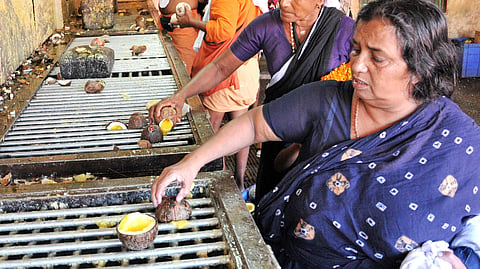
Ghee-filled coconut, one or more as desired by the devotee, is an essential item in irumudikkettu. Devotees break the coconut at a designated spot and submit a portion of ghee for abhishekam in the sanctum. The rest is poured into the neithoni containers at the shrine.
The ghee from the three neithoni containers and the residue from the sanctum flow into large iron-made storage tanks for later retrieval.
Jayakumar said the ghee, after a mechanical heating process, is used for various purposes, including certain rituals, lighting all the lamps and preparing edible prasadams like aravana and payasam. It is also used for cooking purposes in the temple kitchen (thidappally) and staff canteens. Ghee is also sold in packets as a prasadam called “adiyashishtam nei”.
“The idea is to bring in a proper system to measure and track the ghee, how much comes in and how it is used,” Jayakumar said.
The TDB president also responded to the ongoing controversy over alleged malpractice in the purchase of Milma ghee. “The board purchased ghee, reportedly for aravana making. We have decided to avoid this practice in future. Only ghee received from pilgrims will be used during the next pilgrimage season,” he said.
1k litres of ghee daily
The TDB receives close to 1,000 litres of ghee every day during the annual Mandalam-Makaravilakku pilgrimage season
Ghee-filled coconut is an essential item in irumudikkettu. Devotees break the coconut at a designated spot and submit a portion of ghee for abhishekam. The rest is poured into the neithoni containers at the shrine
Ghee from the 3 neithoni containers and the residue from the sanctum flow into large iron-made storage tanks for later retrieval
