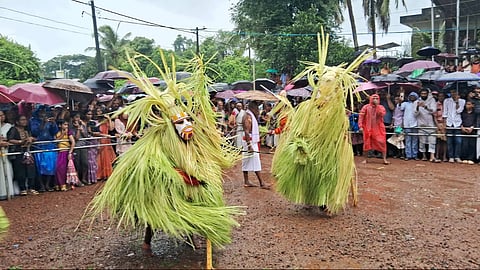

KANNUR: Despite the heavy rain, devotees and spectators turned out in large numbers to witness mari theyyams at Kannur’s Madayi on Saturday.
Mari theyyam is considered as the traditional monsoon ritual art form believed to ward off disease, poverty and sorrow during the Malayalam month of Karkkidakam.
Unlike conventional theyyam performances, mari theyyams follows a unique ritual tradition, beginning at a sacred grove on land, visiting the houses and concluding with a ceremonial procession and final rites in the sea, making it one of the region’s most distinctive performances.
Mari theyyams consist of six distinct deities including Marikaliyan, Mamayakkaliyan, Marikkalachi, Mamayakkalachi, Marikkuliyan, and Mamayakkuliyan.
“Mari theyyam are revered as deities believed to remove the ‘shani’ (the illnesses, calamities and hardships associated with the monsoon) that affect the land and its people.
After the midday puja at the Madayi Thiruvarkattu Kavu, the theyyam descend from a sacred spot on Madayipara. It is believed that once the shani is driven away, the evil spirits are symbolically released into the sea through rituals that include puja and the traditional sacrifice of a chicken,” said Dr Sanjeevan Azhikode, a theyyam researcher from Kannur.
Members of the Pulaya community perform the mari theyyam. The artform was once performed in several regions of the district — including Kannur, Chirakkal, and Madayi. However, the centuries-old ritual tradition has gradually disappeared from most regions and now survives only in the Madayi area, where it continues to be observed as part of the local cultural and religious heritage.
Mari theyyam is distinguished by its elaborate costume, which is predominantly made from kuruthola (tender palm leaves). Mari theyyam and aadi vedan are among the few theyyam rituals traditionally performed during the monsoon season in northern Kerala.
“Mari theyyam and aadi vedan are not merely ritual performances giving blessings. They also symbolise cleanliness and community well-being. In earlier times, during the monsoon, the surroundings of houses would become overgrown with grass, creating the risk of snakes and other reptiles. As part of the preparations to welcome the monsoon theyyams on Karkidakam 16, people would thoroughly clean the areas around their homes. In this way, the rituals also promoted cleanliness and a safer living environment,” added Sanjeevan.
