
THRISSUR: Imagine a little girl growing up amidst the green meadows of Suffolk, in eastern England, spending her childhood among grazing cattle, absorbing the quiet rhythms of rural life.
Half a century later, that same girl would find herself thousands of miles away in Kerala, living in the temple town of Guruvayur, documenting its traditions, embracing its culture and dedicating her life to preserving the artistic heritage of a land that was not her own.
This is the remarkable story of Pepita Seth, writer, photographer, and today one of the most respected chroniclers of Kerala’s cultural traditions.
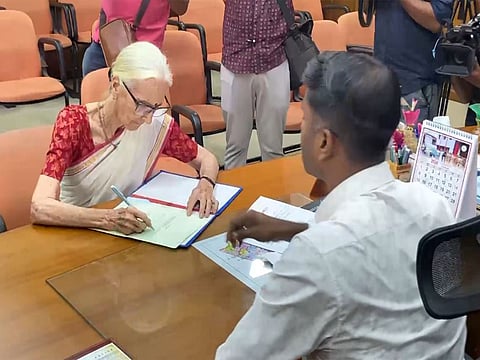
As she celebrates her 84th birthday, friends, admirers and well-wishers are gathering in Guruvayur to honour a woman whose life has become an extraordinary bridge between Britain and Kerala.
Pepita never set out to become an authority on Kerala. Born and raised in the United Kingdom, she developed an early fascination for travel and cultures. India was one among many destinations she hoped to explore. Her journey first took her to Delhi and Mumbai, but it was Kerala that altered the course of her life.
The lush landscapes, the warmth of its people and, above all, its living traditions captivated her imagination. What began as curiosity gradually transformed into commitment. She was no longer content to merely observe. She wanted to understand. Kathakali was among the first art forms that fascinated her.
But the deeper she travelled into Kerala, the more she realised that its cultural wealth extended far beyond the classical stage. She began documenting temple festivals, percussion traditions, village rituals and the vibrant world of theyyam in North Kerala. Armed with a camera and an insatiable curiosity, she spent decades travelling through villages, interacting with artists, performers and local communities, recording traditions with depth.
The call of Guruvayur
Among all the places she encountered in Kerala, Guruvayur left the deepest imprint. The famous temple was not simply another destination on her itinerary. It became home. Living in Guruvayur for years, her engagement went far beyond personal devotion.
She approached the temple as a researcher, studying its history, architecture, rituals, music and traditions. The result was an authoritative work on the Guruvayur temple that continues to be regarded as an important reference for those seeking to understand one of India’s most celebrated pilgrimage centres. Over the years, Pepita made Thrissur her base.
Recognition from nation
India formally recognised Pepita’s contribution in 2012 by conferring the Padma Shri. Having spent more than five decades in India, she applied for Indian citizenship in 2024. Through naturalisation, she officially became an Indian citizen
