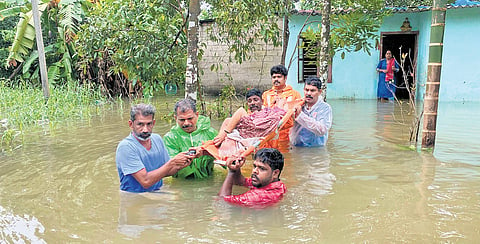

ALAPPUZHA: The continued inflow of water from the eastern high ranges has intensified the flood situation in Upper Kuttanad, forcing authorities to open relief camps and evacuate residents from low-lying areas. Although rainfall has eased slightly, water levels in the Pampa, Achankovil and Manimala rivers remain dangerously high.
Despite the release of floodwater into the sea through the Thottappally Spillway, the persistent inflow from the eastern catchments has slowed the recession of floodwaters. Rising water levels have inundated houses, service roads and agricultural areas in several parts of Thalavady, Muttar, Ramankary, Kainakary and Kavalam panchayats.
The revenue department has opened relief camps in the district, mainly in Kuttanad and Chengannur taluks and shifted 1,300 people. Most affected areas are in Chengannur, from where 759 people have been shifted to 17 camps set up in the taluk.
The overflowing Pampa river has left Nakada in Pandanad West virtually isolated after the RKV-Nakada Road and Nakada-Illimala Road were completely submerged. In Muttani Colony, one of the lowest-lying settlements in the region, floodwaters entered more than 20 houses.
Thankachan, a resident of the colony, said the situation has revived memories of the devastating 2018 Kerala floods. “Nakada is surrounded by the Pampa river on three sides and the Illimala river on the south, making it highly vulnerable to flooding.
Once navigable enough to support the Alappuzha-Ernakulam boat service, the Pampa has lost much of its natural water-carrying capacity due to years of silt and sediment accumulation,” he said.
The Illimala river, which connects the Pampa and Achankovil rivers, is also heavily clogged with silt, aquatic vegetation, fallen bamboo and overgrown shrubs, severely restricting the natural flow of water, he said.
Residents alleged that a `3.52-crore river restoration project prepared under the Restoration of Ecosystem scheme has remained pending government approval since 2022.
Locals said the prolonged delay has left the region increasingly vulnerable to flooding every monsoon.
