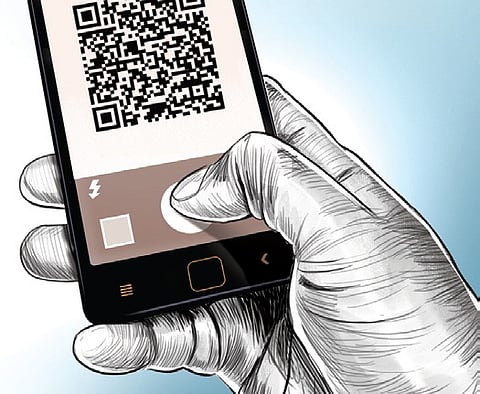

KOCHI: From roadside tea stalls and fish markets to supermarkets, hospitals, and educational institutions, QR codes have become as common as cash counters across Kerala. And, true to its billing as Kerala’s commercial capital, Ernakulam district is leading the state’s shift to digital payments.
The latest district-wise Unified Payments Interface (UPI) data from the National Payments Corporation of India (NPCI) shows that the state’s digital payments ecosystem is maturing fast, with Ernakulam emerging as the undisputed leader in both transaction volume and value.
During the latest reporting period of June 2026, Kerala recorded 454.91 million UPI transactions — 2% of the country’s total volume — valued at `63,489.63 crore, or 2.2% of the national total. At the centre of this digital economy is Ernakulam, which logged 91.24 million transactions worth `11,938.18 crore. The district alone accounted for nearly one-fifth of Kerala’s total UPI volume and value, well ahead of every other district.
Thiruvananthapuram ranked second with 54.74 million transactions worth `7,460.96 crore, followed by Kozhikode with 46.36 million transactions valued at `6,101.46 crore. Malappuram, despite being the state’s most populous district, was close behind with 45.43 million transactions worth `6,026.62 crore. Thrissur, another key commercial hub, rounded out the top five with 40.26 million transactions valued at `5,808.91 crore.
Banking experts say the numbers reflect more than just population. “Ernakulam’s emergence as the leading district for UPI transactions reflects its strong digital ecosystem, high smartphone penetration, and vibrant economic activity.
As Kerala’s commercial hub, it has a diverse mix of retail consumers, businesses, professionals, educational institutions and merchants who have made digital payments part of daily life,” said Indraneel Pandit, chief digital officer, Federal Bank. For Pandit, the scale shows UPI has moved beyond convenience.

‘UPI ecosystem now more inclusive’
“It has become the preferred mode for everyday commerce,” he said, adding that the ecosystem is now more inclusive and efficient.
He credited the numbers to Kerala’s high digital literacy, widespread smartphone use, affordable internet, rapid QR code adoption by merchants, and growing trust in UPI’s security and convenience.
The next phase, he added, will be driven less by onboarding new users and more by increasing the frequency and diversity of digital payments, especially outside major cities.
George K John, executive director, ESAF Small Finance Bank, called Ernakulam’s lead a natural outcome of its economic profile. “The district has a high concentration of businesses, MSMEs, merchants, educational institutions and service industries, supported by a digitally savvy and financially literate population.
High smartphone penetration, reliable internet and strong merchant acceptance of QR-based payments have made UPI the default for everyday transactions,” he said.
John noted that Kochi’s startup ecosystem, strong retail and hospitality sectors, and significant NRI remittance inflows — increasingly spent digitally — have further boosted volumes.
He said the district leading the chart is the result of sustained collaboration among banks, NPCI, fintechs, merchants and regulators to build a trusted, interoperable digital payments ecosystem.
UPI-ee ki yay!
Kerala recorded 454.91 million UPI transactions — 2% of the country’s total volume — valued at L63,489.63 crore, or 2.2% of the national total in June
Ernakulam logged 91.24 million transactions worth L11,938.18 crore during the period