
In a world of complicated existence, ‘maxxing’ has emerged as an internet blueprint for tuning oneself towards focused energy. The slang broadly refers to improving or bringing out the best possible outcome from a particular aspect of life.
From wellness and career to personality and aesthetics, almost anything can be ‘maxxed’. Even doing nothing. They call it ‘Nothing Maxxing’, where the pursuit itself becomes an exercise in switching off.
The vocabulary keeps expanding as social media turns everyday habits, aspirations and identities into lifestyle templates. These trends, born largely in the West, have travelled far beyond it, often prompting debates about whether age-old Eastern practices are simply being repackaged as new-gen fads.

Yoga becoming wellness, dhyana becoming mindfulness, vastu finding its way into contemporary lifestyle terminology.
The latest addition is ‘Lakshmi Maxxing’.
This trend was popularised by Lisa Power, a wellness mentor known online as the Well Witch. It draws on the imagery and symbolism of Lakshmi, venerated in Hindu philosophy as the goddess of abundance, and recasts them as a social media lifestyle aesthetic.
Digital creators on social media have turned the idea into a collection of everyday practices such as decluttering, practising gratitude, maintaining hygiene, dressing mindfully, grooming with purpose and creating serene, well-lit spaces.
The idea is to maximise these habits for a sense of beauty, positivity and abundance. “The most radiant women are all Laxmi Maxxing,” declares a content creator, showing images of Goddess Lakshmi seated on a lotus, clad in pale rose cloth with a golden border and surrounded by an aura of calm positivity.
“The image creates an aura of happiness. That’s the goal. The idea is that once this gets into our system, we can move towards manifesting the same beauty and abundance into our lives,” says Parvathy Kaladhar, a yoga practitioner.
But the imagery goes beyond aesthetics. Jewellery, flowers, clean clothing, serene spaces and, most prominently, the lotus have all become part of the trend.
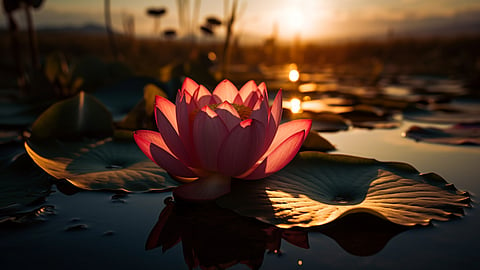
The lotus, however, is more than an aesthetic prop. It carries layers of meaning in Hindu thought. Growing from muddy water while keeping its petals clean and untouched by the dirt, it represents the pursuit of prosperity without allowing wealth or success to become tainted by greed or dishonesty.
“Its blooming evokes self-purification and spiritual awakening — the soul opening to divine truth and enlightenment,” says tattoo artist and spiritual seeker Shyama Devi. “And because the lotus rests on water without allowing water or dirt to cling to its leaves and petals, it also suggests detachment: enjoying material blessings without becoming trapped by them.”
These ideas blend into the social media dynamics. Someone deep into the trend would try to tap into the “Lakshmi energy” by simple methods like cleaning up immediate spaces and ensuring one’s home is bright, says Parvathy.
“Specific care would be on personal hygiene like bathing every day, wearing fresh clothes, etc. This would also translate into bringing Lakshmi Maxxing to your language by practising abundance and gratitude in speech, and being generous,” she explains.
Old practices, new packaging
Spiritualists, however, point out that the trend is just rebranding of concepts long practised in India. “Basically, it is tapping into the feminine energy of positivity that we Indians revere as Lakshmi. We have always been doing it,” says Anusree M, who is part of the worldwide Devi Path network, which began five years ago in celebration of the feminine spirit of nature.
“Lakshmi is not just about wealth and abundance. She is part of the Dashamahavidyas of Prakriti (Mother Nature). She removes all sorts of negativity. The idea is to pave the way for positive feelings that then translate into positive actions. This automatically brings in prosperity, not just of wealth but of other parameters that decide the quality of life. Lakshmi is also the seat of spiritual effulgence and of inner knowledge.”
Jayaraj Thekkethil, a writer who specialises in Indian texts and ancient practices, finds the methodology behind the trend familiar.
“Well, long before the advent of the internet, we had the concepts of ‘Sridevi’ and her elder sister ‘Jyeshta Devi’. The former was Lakshmi, the goddess of abundance, and the latter was of depravity,” he says.
“We used to keep our spaces and minds clean and bright to attract the ‘Sridevi’ and keep ‘Jyeshta Devi’ at bay. Attracting Lakshmi through manifestation, as is seen in the online trend, seems quite similar to this.”
Jayaraj also points to the long tradition of chants and mantras invoking Lakshmi. “We had the Kanakadhara Stotra and the Mahalakshmi Ashtakam, which were chanted regularly for mental purity as well as for positive vibrations,” he says.
“Feminine energy was worshipped as Ashta Lakshmi — for wealth, prosperity, peace, education, health, fertility, family, nature, etc. Whatever we saw around as happiness in nature was attributed to her effulgence.
So, it was not mere material; it was beyond that. The current trend is fine, but one should understand the philosophy behind the practices. Otherwise, it will either remain just another fad.”
Athira Jose, a yoga practitioner and architect, believes a revisit is healthy, especially if it helps the younger generation connect with ancient wisdom.
“The fundamental idea is that whatever we try to manifest in whichever form is energy, which works as per the maxim: ‘As you sow, so shall you reap’. So, always radiate positivity. It will come back to you,” she smiles.
“Eastern culture was based on this, and it is good if the world is beginning to understand this. Soon, we may have more of our culture as Insta trends. Coming up soon are Krishna Maxxing, Dharma Maxxing and Moksha Maxxing!”