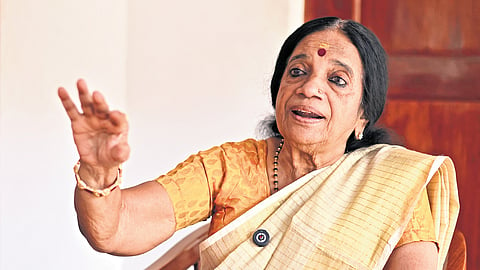

Music has run in her family across four generations. Veteran musician K Omanakutty, sister of the late musician M G Radhakrishnan and playback singer M G Sreekumar, has the rare privilege of guiding thousands of students, K S Chithra and B Arundhati among them, into the world of music. In a candid chat with TNIE, she reflects on her musical life while sharing her thoughts on K J Yesudas, the changing trends in music and why she believes Carnatic music is superior to Hindustani.
Excerpts
You have had a seven-decade-long career dedicated to music. The title of your book, ‘Sangeethame Jeevitham’, meaning music alone is life, seems to capture the story of your own life...
For four generations, we have been into music. My grandfather Parameswaran Pillai was a good singer.My father Malabar Gopalan Nair studied music extensively. He was a great singer and harmonist in ‘sangeetha natakam’. My mother was among the first batch of students at the music academy, along with Aranmula Ponnamma and Parassala Ponnammal. She went on to become a music teacher.
My elder brother too was into music. He was coached by Semmangudi Swami.I took zoology as my optional subject and later turned to music.My younger brother M G Sreekumar studied BCom and turned to music. I thought mygrandson Harisankar – Lakshmi’s son – would take a different path.He studied medicine. But he too turned to music.His younger brother is a violinist.Their father is a musician who served as principal of the academy. Ours is a musical family indeed.
Why did you choose zoology, rather than music, as an optional subject?
Musicians struggled back then. My parents hence wanted me to pursue zoology. I somehow completed my studies. But the course benefited me in another way. My biggest friends in life are my zoology batchmates, not musicians.
Your siblings worked in the film industry. Why didn’t you?
I have sung for a few films, but only classical pieces. My songs include the one in ‘Aaraam Thampuran’. I have sung a total of five or six film songs. I never had much interest in playback singing. My father wanted me to sing classical music. In the music academy, my principal Semmangudi sir too insisted that I pursue classical music.
How did you move to Thiruvananthapuram?
Mrs Pattom Thanu Pillai was a close friend of my mother’s. She pointed out that it would be better to educate children in Thiruvananthapuram. My mother then got a job at a high school in Karamana, and that is how we moved to the city. Mrs Pattom Thanu Pillai would take me to different functions to sing prayers. Many prominent leaders used to attend those programmes — Nehruji, Dr S Radhakrishnan, Rajendra Prasad and Indira Gandhi. That was how people here first began to know me as a singer. Gradually, I started getting more invitations to sing. There was also a samithi called Sajeevavani. They would often invite me to perform at kacheris. I gradually became acquainted with many prominent personalities.
You also share a very close connection with the royal family...
Yes, that relationship goes back almost 65 years. When I was in college, Gowri Parvathi Bayi was pursuing zoology at Women’s College. There was a dance drama in which she was the heroine, and I was chosen to sing for her character. Since the hero also needed a singer, my brother Radhakrishnan too joined. He himself composed the song. Rehearsals went on for nearly six months, and during that period, I developed a close bond with Gowri Parvathi Bayi. The relationship continues to this day.
M G Radhakrishnan as a brother...
There was only a three-year age-gap between us. When I think about him, the first thing that comes to mind is how mischievous he was. He and his friends always used to do something to frighten me or land me in trouble. He also had a wonderful sense of humour. That mischievous, humorous side of him remained unchanged till the very end.

Though he was a great talent, there are many who feel he didn’t attain the heights he ought to have reached...
That’s true. My brother never pursued laurels, nor did he approach anyone for them. Look at his compositions – how powerful is that song ‘Oru Murai Vanthu Parthaaya’... it still reverberates in the hearts of people but never garnered the awards it should have. But my brother was never bothered. When I got Padma Shri, I mentally offered it to my brother. Because he deserved it so much more.
How do you view him as a singer?
He was an excellent Carnatic musician. For 30-35 years, he sang only kacheris, sometimes three in a day. His voice had the flexibility to move in three octaves. He has composed countless songs for Akashvani – semi-classical ones. That was his turning point.
You said MGR (Radhakrishnan) was a very naughty person. He probably preferred to be casual in life too...
Yes. He had so many friends – much more than those of his age usually have. The house had a huge dining table to host his friends, like producer Suresh Kumar. His friends used to mockingly call this home ‘Medayil Restaurant’. He would ask my mother to prepare enough food for all. If no one turned up, he would stand by the gate and ask passersby to come in and have food. He treated all equally. Oommen Chandy, P C Chacko, M M Hassan, V M Sudheeran and Vayalar Ravi were among his innumerable friends.
What about your younger brother (M G Sreekumar)?
Actually, he hasn’t learnt music. But he used to accompany my elder brother for kacheris. He learnt by listening to him for over 18 years. He may not know the name of the raga, but once you start the raga, he would know its structure and nuances, and would sing it. He is gifted that way, and can sing both classical and light music.
Can a person learn to sing just by listening?
In M G Sreekumar’s case, he was born into a house filled with music. Circumstances were conducive. There are two types of jnana – lakshya jnana and lakshana jnana. The second one is acquired, after you are trained in it... like my elder brother and myself. Sreekumar has lakshya jana – which focuses and learns through listening or exposing oneself to similar circumstances.
Which among MGR’s songs do you like the most?
I like all his compositions. Whenever he got a song, he focused on the situation and how it should be sung. He would sing it just once and record it. He wouldn’t modify it much. I like many of his songs – for instance, ‘Suryakireedam’, ‘Mouname’ sung by S Janaki. While rendering the song, she kept recording it till such time she got one particular ‘sangathi’ to her satisfaction, though to the listeners the apparent imperfection was not evident at all. She was such a perfectionist.
And among those sung by Sreekumar?
I like all his songs; but if you have to pick one, it would be ‘Suryakireedam’, which I feel is in a class of its own. There are some songs like ‘Padakaali’, ‘Chandanamani’ that require a specific verbal clarity, which very few can sing. His clarity is so proficient that we can write them down as we hear them. A similar trait is observed in M S Subbulakshmi in Carnatic classical. We need not refer to any texts for the lyrics.
There’s talk that the film ‘Bharatham’ is the story of M G Radhakrishnan and M G Sreekumar...
That’s baseless. They shared a very deep and beautiful bond. Sreekumar always says his elder brother is his guru. Would he say that if he was competing with him?
What are your memories with K J Yesudas?
I have close links with Dasettan. I knew him from childhood. We have interacted closely. A voice like his was never heard before, is not heard now, will not be heard in future either. He is a complete singer who has it all – clarity of words, technique, rhythm. He can deliver much better than what a composer even expects out of a singer. It is a loss that he shifted to America. In another way, it is good too. Social media can be so nasty. Musicians like me feel sad when such unpleasant things are said about someone like Yesudas. He came up the hard way, and even now retains his simplicity. He wants everyone to grow. He once told me he would always ensure that his voice quality stays protected. He cares for it by keeping it ‘safely wrapped in silk’.
Yesudas has faced entry restrictions in some temples. Your take?
Music has no caste or religion. Just think about the songs he has sung. He has sung about all Gods – be it of Hindus, Christians, or Muslims. He’s someone who has shown that music has no discrimination based on caste or religion. His voice touches all deities. If the voice can enter, why not the person?
How do you recall P Jayachandran?
I didn’t know him personally, but his songs are really good. He will not modify a thing from the version he rendered, even if the composer insists. I have seen this in person.
K S Chithra was your student...
I have known Chithra from a very young age. I used to do kacheris with my elder brother, and we would stay at her parents’ house. Her father told me that she had some knowledge. I called her. She came, sat on my lap, and sang ‘Sooryakanthi, sooryakanthi...’. I was astounded – if she could sing that well at the age of 2-3, I was sure that she would reach great heights. She would also come to meet my elder brother in her schooldays. Later, when she was around ten, I taught her a ‘varnam’, for which she won a central scholarship. For years, she would come here even in her college days.
B Arundhati too was your student...
Yes. One of her unforgettable songs is ‘Ethra Pookkalam’. Though she had the calibre to achieve the same heights as Chithra, for some reason, it didn’t happen. It could be because of her background. Unlike Chithra, she would even do kacheris.
Singing or teaching, which makes you happier?
Both are different. When you teach someone, you contribute to many generations, whereas if you sing, you make lakhs of people happy.
Why is the proportion of people enjoying classical music very low?
Very few people enjoy classical music because only they know the science behind it. All of us will have some kind of talent or the other. We have an institution – Sreeragam Foundation – to spread awareness about classical music and identify ragas through film songs, the initiative having entered its fifth edition. After conducting five sessions, we have realised the change it could bring in. We choose multiple songs from the same raga. We also compose a song which has the traits of a certain raga. People sing these songs as part of the programme. It gives you happiness and peace of mind. Those who know music can enjoy it better.
Is learning classical music inevitable to become a good singer?
Yes. Classical is the basis of any song. Every song is based on a ‘swaram’. Knowledge in classical music is inevitable to understand ‘swarasthanas’. All singers note the ‘swarasthanas’ above the lyrics. Seeing the ‘swaram’, they can understand the tune. All singers do so, to not forget. But one female singer would note everything in her mind and sing -- Janakiyamma. She didn’t learn music; she was an avatar.
SPB and Janakiyamma didn’t have formal learning in classical music...
Yes, because they were avatars. Avatars happen rarely. They shouldn’t learn it, instead they contain it. God gave them that gift. Janakiyamma once said that the Paramapurusha or God within her is singing. Her song is equal to God. But she didn’t get what she deserved. Those with deep knowledge and highest eligibility are often sidelined. It is the world’s nature.
Classical concerts were once enjoyed by a specific audience. After the arrival of Nanda Govindam Bhajans, there is a trend that all types of people attend classical concerts...
People love Nanda Govindam not because they are great singers. They sing well, as a team. But the audience of classical music widened not because of their arrival. It started with Yesudas rendering classical music in public events. Even people who don’t know classical music will watch him performing. Dasettan is to be credited for the popularity of classical music. No doubt. In the case of Nanda Govindam, all types of people can sing their songs. Hence, there’s an attraction. So people will go and sing along with them.
There are many people who don’t accept Yesudas as a great classical singer...
There were some classical vocalists who had peculiar mannerism in rendering. But when classical music was available in good sound, people started enjoying it. That is what Yesudas did. Who says that he lacks knowledge? Speak to him for just five minutes and you will understand. Sometimes, I ring up Dasettan. He would speak for two to two and a half hours on different aspects of classical music. I haven’t seen a person with more knowledge. Not that I mean he sings like Semmangudi or others. But he is a great musician. Classical music, films songs, or any other type, he can sing with ease.
You have taught students of various generations. What changes have you observed?
Earlier, students were keen to learn. They did well for themselves. They got jobs, started teaching music. Now, the curriculum in schools and colleges has changed. This gets reflected in students. The semester system has wrecked music education. You perfect music through repeated practice. In semester system, the students have classes for five months. They learn the basics in the first semester, followed by ‘varnam’, ‘keerthanam’ in the second semester. They forget what they learnt in the first semester when they reach the next semester. When they pass out, they do not learn music. The semester system should be done away with, at least in music. The methods are different in music. The first lessons should stay with you till the end.
Nowadays, many children come from reality show backgrounds. Does this aid music appreciation among participants?
That appreciation is of a different kind. Classical music appreciation is permanent, while the other kind is temporary. When one learns classical music, they can deal with the other type easily. Among children, there are some with talent and some without. One in every 30 students learns music with sincerity. But even they don’t get time to learn. There are very few who remember what they learnt in the previous class. But a talented student will remember because he or she has learnt it with sincerity. But when asked to sing film songs, they will do so and even learn them by heart.
Do you think students learn music only for playback singing?
It is indeed a factor. Many learn it to get a chance in playback singing. I believe classical music contests should be stopped. Students who learn by rote lack the aspect of on-the-spot improvisation (manodharmam). In classical music contests, a student who sings best among the contestants is given the prize. There will be a contestant who has the gift of on-the-spot improvisation. But due to selective teaching that promotes rote learning, the talented one misses out.
Which is your favourite raga? Something close to your heart...
It’s like asking a mother of ten which child she likes. I like all ragas. The ones close to my heart are Melakartha ragas; then Kamboji and Mohanam. There are countless different ragas. Earlier, musicians generally sang ragas that were popular and familiar among the masses. Now, there’s a tendency among the younger generations to choose ragas that very few people have heard of. I don’t say it is wrong.
But when a raga is completely unfamiliar to the listener, it becomes difficult to appreciate and enjoy. The younger generation seems more inclined to explore lesser-known ragas. There is nothing wrong with exploring them, but music should ultimately be something that the listener can connect with and enjoy.
There has always been a debate among music lovers over which is superior: Hindustani or Carnatic?
Carnatic. There are innumerable ragas and so many possibilities in Carnatic music. We speak of 72 ragas in Carnatic music, from which countless ragas have evolved. On the other hand, there are just ten ragas in Hindustani music. Carnatic music has an extraordinary range. Its very foundation lies in ‘gamakas’ — the subtle oscillations and movements between notes. But ‘gamakas’ have to be used properly. If they are used unnecessarily or excessively, they can make the music difficult for listeners to appreciate. That is one reason some people find Carnatic music less accessible.
Another very important aspect is ‘shruti shuddhada’, or purity of pitch. When the ‘shruti’ is perfect, it can move us deeply. If the ‘shruti’ is not maintained, the listener will naturally lose interest. But today’s generation gives a lot of importance to ‘shruti shudhada’. In the past, even among experienced musicians, there were many who didn’t pay enough attention to it. In Carnatic music, the same note can be rendered differently in different ragas.
It’s said that Carnatic music demands a certain intellectual engagement. Hindustani on the other hand appears to communicate more directly with the heart. Is this true?
Both Carnatic and Hindustani have to come from the heart. Without emotion, nobody can really sing. Ultimately, music works through both intellect and emotion. When we sing, the vibrations and waves created by the voice reach the listener’s body and mind.
Music touches both sides of us – the intellectual and the emotional. That is why music has such a powerful effect on us. Carnatic music is deeply connected with music therapy. Several ragas are used for treatment. They have an effect even on plants as they too enjoy music.
It’s heard that musicians like Tansen could summon rain by singing?
It’s true. Have you heard about Somayaga? In places where Somayaga is performed, there will be a small drizzle after it ends. I’ve heard a story about how Muthuswami Dikshithar summoned rains during a drought by singing Amritavarshini raga. Later, to stop the rain, he sang ‘sthambhaya, sthambhaya’.
There is an underlying scientific principle to it. The ‘swaras’ of Amritavarshini raga can control the atmosphere. Carnatic music has a lot of such elements. Hindustani singers render the songs with ‘shruthi shudhi’ and people hence feel it’s better. But the reality is that Hindustani can’t hold its own in front of Carnatic music, in terms of theoretical aspects.
TNIE team: Cithara Paul, Anil S, Parvana K B, Anna Jose B P Deepu (photos)