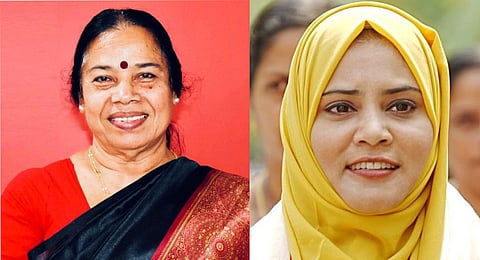

KOZHIKODE: Reacting to the controversial circular issued by the Kanthapuram faction of the Samastha Kerala Jam-iyyathul Ulama, former minister and CPM leader P K Sreemathy has asked IUML MLA Fathima Thahiliya to state her position on the remarks that critics say seek to restrict women’s presence in public spaces.
The controversy centres on a circular issued to Mahals, which reportedly cautioned against allowing young women to appear among unrelated men in public places, on roads, and on stages, and urged that religious programmes be conducted strictly according to Islamic norms. The circular also called for avoiding what it described as non-Islamic customs and practices during religious celebrations.
Taking strong exception to the remarks, Sreemathy directly addressed Thahiliya, describing her as a “dear younger sister” and asking what her response was to the directive that women should not be “displayed” among unrelated men.
Sreemathy drew a parallel between what she described as conservative interpretations of Islam and patriarchal provisions associated with the Manusmriti, arguing that both ultimately deny women an independent identity.
“Manusmriti and conservative anti-women attitudes in Islam are two sides of the same coin,” Sreemathy said, arguing that while one pushes women into the confines of the household by making them subordinate to men, the other seeks to restrict women’s bodies and voices from public spaces in the name of religion.
She said women have an identity and existence of their own and argued that society should collectively oppose any mindset or language that reduces women to objects or instruments.
The controversy has also drawn a response from fellow party leader K K Shailaja, who described the position attributed to the Samastha faction as outdated and “extremely anti-women”. Shailaja argued that keeping women confined to their homes was part of a feudal social order and that such a position was unacceptable in contemporary Kerala.
She pointed out that Muslim women in the state are now well-educated and active in diverse fields, including politics, administration, law, medicine, education, technology, and other professions.
Muslim women serve as MLAs, municipal chairpersons, panchayat presidents, and other elected representatives, she noted.
