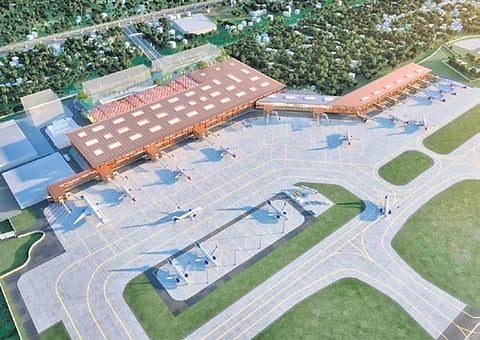

THIRUVANANTHAPURAM: Clearing a major hurdle, the proposed `8,707-crore expansion of Thiruvananthapuram airport has secured a suggestion for green clearance from the State Expert Appraisal Committee-1 (SEAC-1).
The committee recommended integrated environmental clearance (EC) along with coastal regulation zone (CRZ) clearance for the project for a period of 10 years.
The decision taken at the 217th SEAC-1 meeting chaired by Anirud Kumar Dharni, chairman, SEAC-1 (South Zone) Kerala, paves the way for final EC order by State Environment Impact Assessment Authority (SEIAA), allowing the airport to move forward with massive infrastructure upgrades planned over the decades.
Under the project by Thiruvananthapuram International Airport Ltd (TIAL), the airport will scale up its passenger handling capacity to 27 million passengers a year. Cargo capacity will jump to 4.2 lakh metric tonnes annually.
The clearance comes at a time when the state government is focusing on seaport and airport led development.
For travellers, the expansion brings redesigned terminals in two stories, modern digital systems for faster check-ins, upgraded aircraft parking areas (aprons), and smoother flight connecting paths (taxiways). A state-of-the-art cargo complex is also planned.
A hotel project coming up at the entrance will be integrated into the master plan.
To meet safety standards set by Directorate General of Civil Aviation (DGCA), the airport will need an additional 6.88 hectares of land alongside its current 248.29-hectare campus.
Devpt worth Rs 3,700 crore in phase-I
According to a TIAL official, the first phase of the expansion includes upgrading the passenger capacity from 4.5 million to 12 million by 2032. “In the first phase, development worth Rs 3,700 crore will happen on existing land without disrupting traffic. We have started the work and a fresh investment of Rs 2,400 crore will happen from April 2027. We will require the land for further expansion after 2032,” said the official.
Thiruvananthapuram airport is managed by TIAL, a special purpose vehicle under Adani Airport Holdings Limited. The investments are done in a phased manner to regulate airport user fee as per the Airport Economic Regulatory Authority mandate. The Kerala Coastal Zone Management Authority (KCZMA) had issued its formal CRZ recommendation in December 2025 following an environmental public hearing in August 2025. However, expansion plans faced hurdles as authorities directed TIAL to resubmit its proposal to address public concerns.
The SEAC had earlier noted that the initial corporate environmental responsibility (CER) plan submitted was unsatisfactory and directed TIAL to clarify earth excavation requirements and submit a revised CER. A revised CER was submitted in May 2026. In it, TIAL clarified that excavated material will be stored within the project site and utilised for level raising, backfilling and construction activities, while following required procedures if external sourcing or transportation becomes necessary.
TIAL also allocated Rs 84.45 crore in capital expenditure and an annual recurring budget of Rs 4.08 crore for its Environmental Management Plan (EMP). It set aside Rs 21.765 crore for CER initiatives – funds legally mandated for local community welfare – across 33 neighboring villages.
Finding the additional details satisfactory, the committee cleared the proposal with specific conditions. These included routing stormwater runoff through designed oil-water separators and silt traps before discharging into the adjacent Parvathy Puthanar canal to prevent contamination, maintaining a dedicated green area of 2 hectares as per the Landscape Master Plan and prioritising transplantation of timber-yielding species for the roughly 280 trees impacted by the expansion.
The government has approved the allocation of 15 acres to meet the regulatory requirements.
5 sectors covered
The revised CER, submitted in May, establishes monitorable physical targets and specific budgetary allocations across 5 major sectors: environmental sustainability, community health and sanitation, education & skill development, infrastructure development, and livelihood support
