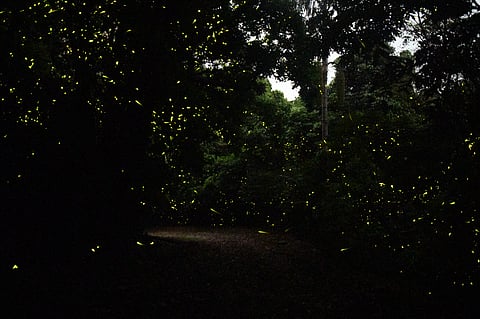

When stars descend to earth, they become fireflies.
Darkness comes alive with tiny magical flickers. They drift silently through the air like fairies wandering the wilderness. And you gaze at them, mesmerised.
In fantasy, that is.
In reality, they are insects. Or, more precisely, beetles. Yet few creatures blur the line between science and magic quite like they do.
With the arrival of the monsoon, these tiny natural lanterns once illuminated backyards, paddy fields and village paths across Kerala. Today, however, our encounters with them are increasingly confined to the snaps shared by wildlife photographers.
Those images reveal a breathtaking spectacle called a congregation.
“It is when hundreds of adult male fireflies gather after dusk, flashing their lights to attract females waiting on the ground,” explains Bijoy C, assistant professor and head of the Shadpada Entomology Research Lab at Christ College, Irinjalakuda.
“It is almost like a swayamvaram,” he says. “The glowing males fly above while the females choose their mate.”
Such congregations, he recalls, were once common across Kerala, especially rural and suburban areas.
“They were visible wherever nights were truly dark, before artificial lighting became widespread. Now they have become increasingly difficult to find,” Bijoy notes.
Ironically, despite the Western Ghats being one of India’s richest habitats for fireflies, very few researchers have studied these enigmatic beetles.
“It is quite surprising that there are not many people working on fireflies,” says Bijoy.
His own journey into the field happened almost by accident. “My research centred around insects, but never specifically on fireflies. I entered the field quite unexpectedly,” he adds.
The turning point came during the pandemic. Inspired by World Firefly Day celebrations, his students proposed a project documenting firefly sightings around their homes.
“I asked them to record the date, time and place whenever they spotted fireflies over two months. Almost all of them reported very few sightings,” Bijoy recalls.
“That’s when I also realised something had changed. These insects were once abundant around us, but had become surprisingly rare.”

From then on, Bijoy began focusing on fireflies. Searching for literature revealed another surprise.
Apart from international reports warning of declining firefly populations worldwide, there was little information available about Indian species.
“Research was scarce. We didn’t even know what species occurred in India,” says Bijoy.
Fireflies had received attention during the colonial period, he notes, but systematic research virtually disappeared afterwards.
“The British studied them, but much of that work and the collections went back to Europe. Only recently have Indian researchers begun compiling a proper list of our firefly species,” he says.
So far, around 90 firefly species have been recorded in India. More than a quarter are found in the Western Ghats.
Among the researchers leading this effort is 29-year-old Parvez, whose work focuses largely on the Western Ghats.
“He is one of the first researchers in India concentrating on fireflies,” adds Bijoy.
Parvez’s journey also began in 2021, during the pandemic.
“When I was preparing for a PhD on rare insects, I found almost nothing about fireflies. That itself prompted me to focus on them,” says Parvez, who is currently in China presenting a paper on firefly rearing.
The lack of information was astonishing. “When I started, only nine species were listed online from India,” he says.
“As our work progressed, we realised several of them weren’t even found here. The information was so sparse that I had to begin almost from scratch.”
His research took him across the Western Ghats. “I still remember seeing a firefly for the first time after 25 years,” Parvez says.
“I grew up in Delhi, where they had disappeared from urban landscapes. It was in Chikkamagaluru that I saw them again. It remains one of the most memorable moments of my life.”
Globally, more than 2,600 firefly species have been documented. “Yet not even 10 per cent have been studied in detail,” he says.
Parvez and fellow researchers have now established a firefly data centre at Kannur University, which also hosted India’s first international seminar on fireflies earlier this year.
“More researchers are entering the field now,” he says. “We finally have enough information to build a proper research centre.”
What still amazes him is how little scientists knew until recently. “When I started, we barely understood who these insects were, how important they are, or the role they play in the ecosystem.”
Studying them is anything but easy.
Many species take one to two years to complete their life cycle. The larval stage lasts the longest, while the adult beetles survive for only three to four weeks.
Spotting larvae in forests or fields is extremely difficult. Fireflies pass through four stages — egg, larva, pupa and adult. Even the larvae and pupae emit a faint glow to deter predators.
During the larval stage, which can last from six months to over a year, they feed voraciously on snails. As adults, they live for only 21 to 28 days and are believed to spend that brief period almost entirely on reproduction.
“Once they were everywhere—paddy fields, sugarcane fields, turmeric farms, wild patches and even backyards,” says Parvez.
“Ask almost anyone, and they will tell you that fireflies are disappearing. But scientifically, we still don’t have enough data to say that conclusively.”
The biggest reason is simple: nobody was studying them.
“There is no historical data to compare populations over time. So when people ask whether fireflies are declining, we can only say that all available evidence points in that direction,” says Parvez.
Among the greatest threats is light pollution. “They glow to attract mates. Without successful communication, they cannot reproduce,” he adds. “But nights are no longer dark. Urban areas, suburbs and even villages remain illuminated.”
Fireflies are also extraordinarily sensitive to changes in their surroundings.
“They require humid weather, healthy soil and dark nights,” says Parvez. “Even removing a single tree from an area where fireflies occur can significantly reduce their numbers within a year.”
The increasing use of herbicides and pesticides creates another threat. “The chemicals destroy firefly larvae in the soil,” says Bijoy. “That is one reason we are now seeing more snails.”
Recent studies underline the urgency. A 2021 study in the US identified 18 firefly species facing extinction. In India, a recent nationwide census conducted in collaboration with the Wildlife Institute of India reported a 76 per cent decline in firefly numbers across surveyed locations within a year.
“It is time we protect their habitats — not for tourism, but for conservation,” says Bijoy. “These natural pest controllers play an important role in maintaining ecological balance.”
Otherwise, Kerala may slowly lose one of its most enchanting sights. Ask around the Gen Z crowd, and see how many have seen fireflies in real life. And remember, with every disappearing glow, the imbalance beneath our feet may only continue to grow.
Box:
Behind the light
Fireflies glow due to a chemical process called bioluminescence. Inside specialised cells in their abdomen, they combine chemicals like luciferin, the enzyme luciferase, and oxygen, using energy from food they stored when in larvae form. This reaction produces ‘cold light’ that emits almost no heat. The glow pattern of each species is different to attract mates from their own kind.