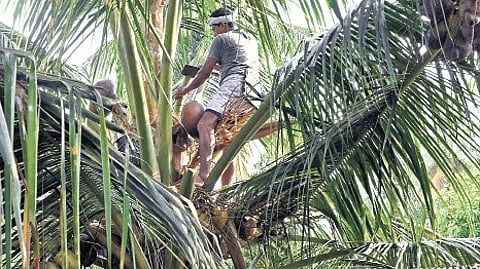

PALAKKAD: For decades, the Chittur region in Palakkad has been the beating heart of Kerala’s toddy industry, supplying the traditional beverage to every district except Kannur and Thiruvananthapuram.
Now, the state’s toddy capital is facing an existential crisis as production has plummeted and experienced toddy tappers are leaving in large numbers for neighbouring Tamil Nadu.
Industry representatives, toddy workers and coconut farmers point to two interlinked challenges: a steep decline in toddy yield from coconut palms and a severe shortage of skilled tappers, threatening the sustainability of Kerala’s traditional toddy sector.
Although the Chittur region is licensed to produce up to three lakh litres of toddy a day and has permission to tap around 1.9 lakh coconut trees, actual production has dropped drastically. Workers’ organisations estimate that daily output now struggles to cross 40,000 litres.
The falling yield has triggered large-scale migration of tappers to Tamil Nadu, reversing a labour movement that had continued for nearly 40 years.
Until recently, Chittur depended heavily on toddy tappers from both Kerala and Tamil Nadu. Workers’ organisations said the region once had around 2,500 tappers from Kerala, mainly from Ernakulam, Alappuzha and Kottayam districts, besides nearly 3,000 workers from Tamil Nadu, largely belonging to the Nadar community. Those numbers have now dwindled to around 150 and 400, respectively.
“The migration has been driven by improving prospects across the border,” points out Sathyan Nattukal, the Palakkad district secretary of the INTUC-affiliated Kerala Toddy and Abkari Workers Congress (KTAWC).
Rainfall deficit and diseases affecting coconut palms behind decline in toddy production
“Toddy tapping has become increasingly active in Tamil Nadu’s Pollachi, Coimbatore, Udumalpet and Anamalai regions, where toddy is primarily procured by cooperative jaggery manufacturing societies for the production of palm sugar and related products,” Sathyan says.
Industry sources say the toddy workers in Tamil Nadu also sell (though illegal in the state) limited quantities of toddy directly within coconut groves from leased plantations, creating an additional source of income. These favourable conditions have attracted hundreds of experienced toddy tappers from Chittur to the neighbouring state.
“Ironically, the migration marks a complete reversal of the trend that began in 1987, when TN imposed a ban on toddy production and sale. The prohibition prompted thousands of workers to cross into Kerala, where toddy tapping was among the state’s best-paying traditional occupations. Chittur, with nearly 1,200 coconut groves, subsequently emerged as Kerala’s principal toddy-producing region,” Sathyan says.
Yields collapse as coconut palms grapple with disease
Workers attribute the exodus primarily to the sharp decline in toddy production caused by prolonged rainfall deficit and widespread disease affecting coconut palms. In Tamil Nadu’s high-yielding Pollachi belt, a tapper can collect 120 to 150 litres of toddy a day from just 30 coconut trees, they say. In contrast, workers in Chittur often struggle to obtain even 30l from the same number of trees.
The production crisis has been aggravated by widespread disease affecting coconut plantations in the border panchayats of Perumatty, Eruthempathy, Vadakarapathy, Kozhinjampara and Muthalamada. Farmers say nearly 3.5 lakh coconut trees have been affected over the past five years by diseases including yellowing, crown-related disorders and other infestations, besides damage caused by strong winds.
Allegations over adulterated toddy
Despite the steep fall in genuine toddy production, workers allege that the quantity of toddy distributed across Kerala has remained largely unchanged.
According to toddy workers’ organisations, the gap is allegedly being filled by adulterated toddy prepared using rectified spirit and harmful chemicals, enabling supply to match the licensed distribution quota. They argue that the issue requires stricter monitoring and enforcement to protect consumers as well as genuine producers.
They have warned that unless immediate steps are taken to improve coconut health, increase toddy yields and retain skilled workers, Kerala’s traditional toddy industry could face a deeper crisis.
For Chittur, the challenge is now about ensuring the survival of an industry that has shaped the region’s economy and identity for generations. “We expect quick intervention from the UDF government,” Sathyan says.
