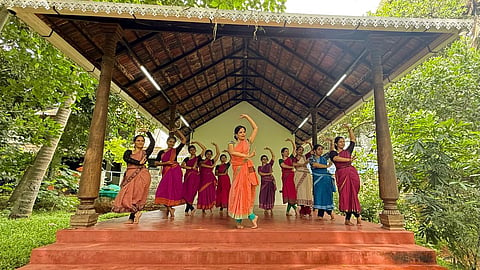

Every weekend, the Sanjali Centre for Odissi Dance at Ambalamukku in Thiruvananthapuram comes alive with the graceful rhythms of Odissi. The classes, led by Sanjay Tapse, reflect a quiet but noticeable shift in Kerala’s classical dance landscape, where the centuries-old dance form from Odisha is steadily finding new admirers.
For Sanjay, an engineer, the journey into Odissi began unexpectedly. Until 2019, he was simply an admirer of classical dance.

Drawn more by aesthetics than technique, he attended an Odissi workshop by Padma Shri Madhavi Mudgal in Thiruvananthapuram. The experience proved transformative.
Soon, he immersed himself in Odissi, the temple-born dance form renowned for its sculptural poses, fluid movements and deeply expressive storytelling set to layered music and poetic lyrics.
“I used to travel to Bengaluru every weekend to learn from Sharmila Mukherjee, disciple of the legendary Kelucharan Mohapatra, who runs the Sanjali Centre there. After completing my training, I was asked last year to take charge of the newly opened Thiruvananthapuram branch,” says Sanjay, who has since been training students and performing with the Sanjali ensemble in the capital.
Speaking to TNIE from Bengaluru, Sharmila says she sensed a growing appetite for Odissi during her frequent visits to Kerala.
“Our workshops received an overwhelming response. We also performed at Soorya Festival, Nishagandhi and several other venues. Many people approached us asking where they could learn the form. That encouraged us to open a centre in Thiruvananthapuram,” she says.
The growing interest has prompted other institutions to expand as well. Nrityantar Academy of Performing Arts, founded by Madhulita Mohapatra, is planning to open a centre in Thiruvananthapuram after conducting successful programmes in Kochi and Thrissur.
“We have presented performances across Thiruvananthapuram, Varkala and Kochi, besides organising workshops and residential camps. Many Malayali students later enrolled for our online classes, encouraging us to think of a permanent presence here,” says the academy’s Kerala coordinator, Mini Somakumar.
Mini herself discovered Odissi nearly a decade ago after watching Madhulita perform. “I had no classical dance background, but I was captivated by the sheer elegance of the form,” she says.
While Odissi is relatively new to Kerala’s dance ecosystem, northern classical styles have had a presence in the state for years. Institutions such as Natyaveda College of Performing Arts, affiliated with Indira Kala Sangeet Vishwavidyalaya, Khairagarh, have long taught Kathak and now also offer diploma courses in Odissi.
“Kathak gained popularity partly because many believed it would help with cinematic dance, though that is more assumption than fact. Odissi’s appeal is different,” says classical dancer Sobha Antharjanam, founder of Lalithodayam Nrithyalayam.
She recalls that Odissi first entered Thiruvananthapuram’s teaching circuit about two decades ago through a local dance school that invited guru Trinat Mahapatra. Later, he conducted workshops at Bharatakshetra, where Sobha’s daughter Uttara trained.
“She is now pursuing a PhD in Odissi at JNU. Before that, she trained around a dozen students at my institute, who even staged a performance last year,” says Sobha.
According to Doordarshan B-High graded dancer Dhanya V S, Kerala has always shown an openness to embracing new classical traditions.
“Kuchipudi was once a novelty but is now firmly established. Kathak followed the same path. Odissi is the latest to capture people’s imagination,” she says.
Dhanya believes the dance resonates with Malayalis because of its familiar cultural vocabulary. “Much of its repertoire is in Sanskrit and draws heavily from Jayadeva’s Ashtapadi and the Radha-Krishna tradition, themes Keralites readily relate to,” she says.
“The movements are subtle, and the silver ornaments and costume aesthetics have a rooted, folk-inspired simplicity.”
Dhanya notes that many young dancers learn two or three styles simultaneously these days. “Exploring different forms is valuable, but serious study requires immersion,” she says.
“However, the fact that audiences and students are embracing diverse traditions can only enrich Kerala’s artistic landscape.”