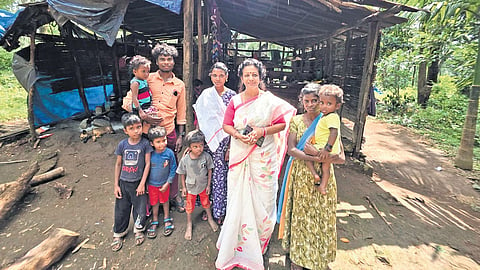

THIRUVANANTHAPURAM: For months, social worker M S Sunil has been tirelessly overseeing the construction of a score of houses for families belonging to the Malampandaram tribal community in Manjathode, Laha, Pathanamthitta.
Four of the residences are near done, with the rest at various stages of completion. But the project has hit a roadblock, not because of funding or labour shortage, but because providing basic amenities such as water and electricity to the remote forest settlement has become a major challenge.
“People think once the walls go up, the work is over. But without water and electricity, these houses cannot become homes,” Sunil said.
The beneficiaries are Malampandaram tribal families who have government-allotted land but continue to live in hamlets without permanent housing. Sanctioned by the District Legal Services Authority, the project involves the construction of 20 houses.
Of these, the four nearing completion have been provided with a basic electricity connection. However, none has access to a dependable source of water. The limited supply made available through the tribal development department is inadequate even for families who already rely on it for drinking, cooking, bathing and washing.

Sunil hopes to provide a permanent water connection through the Plappally pumping system or any other feasible source. “The existing supply is not enough for even the basic daily needs of these families, most of which have eight to ten children. Unless a permanent water source is arranged, people cannot move into these houses,” she noted.
Situated within forest terrain, the site has no easy access. Every stage of construction begins with clearing pathways, creating space and transporting materials through difficult terrain. Extending water pipelines and electricity connections to the settlement has posed practical challenges that have slowed the project.
Unlike conventional housing projects, there are no contractors or intermediaries involved. The initiative follows a simple model. One sponsor, one house.
Anyone willing to support the project approaches Sunil directly and sponsors the construction of a house. The 65-year-old supervises every stage of the work with her own team of workers, ensuring that the money reaches only intended beneficiaries.
“I don’t ask anyone for money. If someone wants to build a house for a family, they come to me. There are no middlemen. Every rupee entrusted to us is spent on that family’s house,” Sunil, who hails from Azhoor, Pathanamthitta, pointed out.
Working without intermediaries, she says, has never meant compromising on quality.
Each house has a minimum built-up area of around 650 sqft with two bedrooms, a hall, a kitchen and a sit-out. Depending on the sponsor’s contribution, additional facilities can be incorporated.
“We use quality materials throughout. Even if a door or window is second-hand, we make sure it is durable and suitable for the house,” she stressed.
The housing initiative is the continuation of a journey that began years ago when Sunil was a teacher at Catholicate College in Pathanamthitta. One of her students, Asha, had neither land nor a house. Moved by her circumstances, Sunil mobilised funds through crowdfunding and built a home for her.
She has completed 380 houses across Pathanamthitta for families who either had no house or were living in structures that had become unsafe and uninhabitable. Sunil has been working among the Malampandaram families of Manjathode since 2005 and has closely seen their struggles over the years. “It is difficult to accept that even in 2026, these families still do not have access to basic facilities,” she said.
The need for permanent housing, she says, goes beyond comfort. The settlement lies along routes frequently used by elephants, making sturdy houses a matter of safety as well.
“Walls have been raised, roofs have been laid and doors have been fixed. But until water and electricity reach every household, the promise of a permanent home for the families will remain just out of reach,” she said.