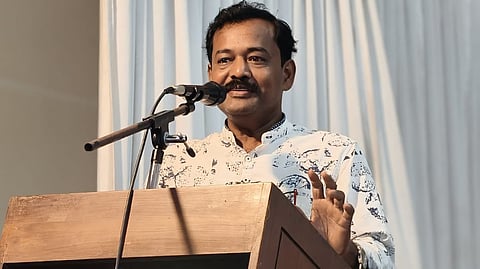

MALAPPURAM: “The greatest sadness is that there is no one left to speak Mygurudu. I am still searching for people from anywhere in Kerala who know the language.”
Those words from Pramod Irumbuzhi reflect the quiet disappearance of a centuries-old linguistic tradition.
A higher secondary school teacher from Malappuram, Pramod is regarded as the lone custodian of Mygurudu, a secret language once spoken by Mappilas in Malabar and believed to have been used during the Malabar Rebellion by the warriors during their prison period. He has documented his research in the book ‘Malappuram Bhasha My Gurud’.
Pramod first came across a reference to Mygurudu while studying at Calicut University. A passage in K K Baburaj’s ‘The Secret Language of the Panans’ mentioned that the Mappilas of Malappuram had their own secret language. The brief reference sparked his curiosity and set him on a journey to trace its surviving speakers.
The breakthrough came unexpectedly while he was working at his father’s medical clinic in Irumbuzhi after completing his studies. At a nearby tea shop, he overheard two local men, Valiyakuzhiyil Muhammed and Thorappa Muhammed, conversing in an unfamiliar dialect.
“When I asked them about it, they were reluctant to reveal anything. Later, Valiyakuzhiyil Muhammed told me that it was Mygurudu, the secret language once used by the Mappilas of Malappuram,” Pramod recalled.
Valiyakuzhiyil Muhammed went on to teach him the language, its grammatical patterns and secret verses. Every time they met, the two would converse only in Mygurudu.
“After both Valiyakuzhiyil Muhammed and Thorappa Muhammed passed away, it became extremely difficult to find anyone who could speak the language fluently,” he said.
What began as personal curiosity gradually turned into a mission to preserve a fading linguistic heritage. Pramod organised annual gatherings in Malappuram, Manjeri and Irumbuzhi, bringing together people who knew the language and those interested in learning it. The initiative attracted growing interest, but the momentum was disrupted by the Covid-19 pandemic. Meetings shifted online, with nearly 15 WhatsApp groups becoming platforms for learning and discussion. As the years passed and native speakers dwindled, the conversations gradually fell silent.
Another fluent speaker, Karakkadavath Hassan, also died during this period. Today, Pramod continues his efforts to preserve the language despite having no one with whom he can converse in Mygurudu.
According to Pramod, references to Mygurudu can also be found in historian A K Kodoor’s book ‘Anglo Indian’, which suggests that the language dates back to the 15th century. It is believed that peasants, fearful of landlords, used the coded dialect to communicate without being understood.
The language follows a distinctive system in which Malayalam letters are substituted with others. For example, the letter sounding “Ra” is used in place of “Cha”, while “Pa” replaces “Na”, creating a coded form of speech that remained unintelligible to outsiders. Mygurudu also gained prominence among workers in beedi manufacturing units across Malabar during the 1950s and 1960s. As the beedi industry declined and factories shut down, the language too slowly disappeared from everyday use.
Pramod initially believed that Mygurudu was confined to Malappuram. However, his research later uncovered traces of the dialect in Thrissur, Ernakulam, Kozhikode, Palakkad, Wayanad, Kannur and other parts of Kerala, indicating that the language once had a much wider presence than previously thought.
As his search continues, with each passing year, he hopes to find at least one more speaker who can help keep alive a language that once echoed across Malabar but now survives largely through the dedication of a single man.
