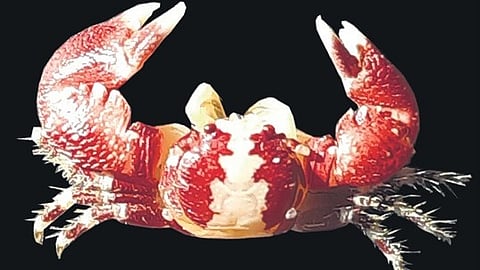

KASARAGOD: The ICAR-National Bureau of Fish Genetic Resources (NBFGR), Kochi regional centre, discovered two new marine organisms from Indian waters.
The discoveries include a tiny porcelain crab, as tiny as 3mm, from the coral reef ecosystem of Lakshadweep as well as a new snake eel from the Bay of Bengal at Kakinada in Andhra Pradesh. The discoveries were published in international peer-reviewed journals.
The crab was collected from the coral reefs of Agatti Island in Lakshadweep by NBFGR researchers B Sureandiran, Divya P R, Sendhil Kumar and T T Ajith Kumar. The researchers said it belongs to the genus Pachycheles, which plays important ecological roles in coral reef ecosystems through nutrient recycling and maintenance of ecosystem health.
The new species was named Pachycheles Ravichandrani in honour of Dr M Ravichandran, former secretary, Ministry of Earth Sciences (MoES), Government of India, in recognition of his significant contributions in advancing marine biodiversity exploration through India’s Deep Ocean Mission.
Meanwhile, another team of researchers E R Sangamithra, N K Suyani, A Kathirvelpandian, R K Behera, S Acharya, A Mohapatra, K Chakraborty, and T T Ajith Kumar from NBFGR discovered a new species of snake eel naming it, Bascanichthys Chepakakiensis.

The species name is derived from Telugu words, chepa meaning fish and kaki, a shortened form of Kakinada, the locality from where the specimen was collected. The name collectively reflects both the local language and the geographic origin of the species.
Dr T T Ajith Kumar, head of NBFGR Kochi regional centre, led the two teams supported by the Ministry of Earth Sciences.
The discovery of these species underscores the vast and largely unexplored marine biodiversity of India, said NBFGR director Dr Kajal Chakraborty. Despite significant progress in biodiversity research, many marine organisms remain undocumented. “We continue our scientific exploration to discover more species from Indian waters.”