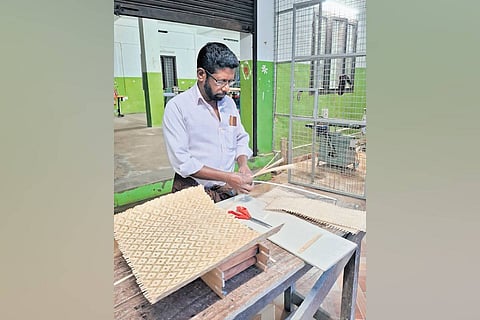

KOCHI: ‘Kannadi paya’, or mirror mat, made by the members of the Urali tribe at Venmani in Idukki district, is globally recognised and has been granted the Geographical Indication (GI) tag. However, the time may not be far when this tribal art fades away into the annals of history, for there appears to be little interest among the Urali tribe’s new generation in learning the art.
Taking note of the urgency of the matter, the forest department has launched a unique programme that would see the youngsters from the tribe being trained in making value-added products like clocks, lamp shades, purses and the like from mirror mats.
“The forest department approached the Kerala Forest Research Institute (KFRI), seeking its help in arriving at value-added products. KFRI then turned to the Venmani Adivasi Vana Samrakshana Samithi (AVSS) in developing a project,” P Jineesh, beat officer and Venmani AVSS secretary told TNIE.
After a thorough market study, the AVSS arrived at the conclusion that the global market has a good opinion about the quality of Venmani mirror mat. “Hence, if value-added products are made using the mat, it would capture the handicraft market easily,” he said.
It was understood that the manufacturing of value-added products from the mat would not only secure the future of ‘kannadi paya’ but also turn it into a lucrative opportunity for the younger generation of the Urali tribe to earn a livelihood, Jineesh said.

As a first step, AVSS brought out a manual according to which young tribespeople would be trained in not only weaving the mat but in making various value-added products as well. “Training was structured as a 15-day programme and is held at the Venmani Parapalavu Bamboo Pressing Unit. As part of the programme to conserve mirror mat making, AVSS also has plans to make available the raw material. We will be planting reed bamboo, known locally as njoonjiletta, in the forests,” he added.
At present, there are around 2,000 reed bamboos planted by AVSS members inside the forest.
“It takes around 30 days to make one mat. A finished mat is priced at `40,000 in the market. However, the time taken and the effort that needs to be put in makes the younger generation shy away from the traditional art of making mirror mats. But things can be turned around if the state government launches projects that make the traditional art form lucrative for the younger generation,” Jineesh said.
All these handicraft products made using mirror mats will be sold through the Vanasree Eco Shops run by the forest department.