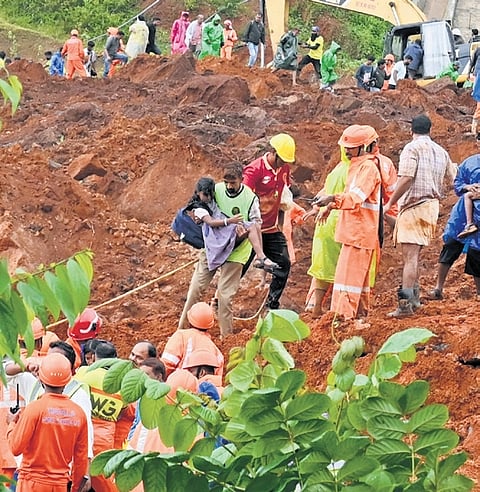

KOCHI: The landslip at the under-construction Anakkampoyil-Kalladi-Meppadi twin tunnel project site in Wayanad on July 7 was not an unforeseeable tragedy but one that had been repeatedly flagged in advance, according to a report submitted by the amicus curiae before the Kerala High Court. It also stated that the government and the public works department cannot shrug off the responsibility of ensuring compliance of environmental clearance conditions.
“On a preliminary understanding, the Kalladi disaster of July 7 was not unforeseen; it was foreseen, in writing, five times over,” stated the report.
Stating that the authorities disregarded the repeated statutory warning, the amicus curiae pointed out that the District Disaster Management Authority/district administration, Wayanad, issued as many as five successive written communications to the Kerala PWD/ executing agency requiring steps to be taken to avert a disaster by removing the dumped soil.
“These directions were not complied with. The DDMA had also directed the company to remove the soil, but it did not,” said the report filed in response to a case initiated suo motu for prevention of natural disaster in the wake of the Mundakkai-Chooralmala landslides on July 30, 2024.
‘Govt cannot shrug off responsibility’
According to the report, the state government and PWD have the principle responsibility for complying with the conditions in the environmental clearance. Hence, under the guise of the entire construction activity being handed over to Konkan Railway Corporation Limited, the state government, especially the PWD, cannot shrug off responsibility, it said.
The report pointed out that as per the minutes released by the PWD, the inspection found that the huge pile of excavated soil posed a risk of soil piping and slope instability and that the retaining wall andthe tarpaulin cover provided by the contractor were inadequate against water seepage.
It had also found that the height of the soil dump should be reduced and the families residing near the Meenakshi bridge should be moved to safety in the event of heavy rain. The contractor was reportedly asked to stop work on June 27, there being, in any event, a standing instruction against construction activity during the monsoon.
The report suggested that the Kerala State Disaster Management Authority (KSDMA) shall issue an interim standard operating procedure (SOP) for all ongoing projects in landslide-susceptible zones covering monsoon stop-work windows, limits on dump height and slope, drainage, cover, instrumentation and evacuation triggers.
Automated rain gauges and slope-movement sensors with threshold-based public alerts shall be installed at the project site and other identified sites before further work is permitted.
The report also stated that under the general criminal law, the deaths prima facie attract investigation under the Bharatiya Nyay Sanhita, including Section 106 (causing death by negligence), and cognate provisions relating to act endangering life. The investigation should extend not only to the contractor but to every officer or agency whose act or omission contributed to the retention of the muck pile despite written warnings.
