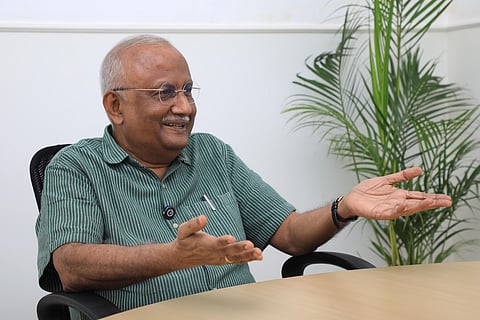

He was among the rare breed of bureaucrats who preferred to keep a low profile while doing the job in the most competent manner. He was never a ‘media darling’, but the general public looked up to him as one of the architects behind the much-appreciated People’s Planning initiative.
As ‘Janakeeyasoothranam’ is completing 30 years, former chief secretary S M Vijayanand, who has served under both Oommen Chandy and Pinarayi Vijayan, shares with the TNIE his thoughts on People’s Planning, experiences with the two CMs, PM Narendra Modi, and why he finds IAS officers making public political remarks totally unacceptable.
Excerpts
It’s been 30 years since the state launched the revolutionary concept of people’s planning. How do you assess the changes that it brought in?
Going by the expectations back then – if you look at what we dreamt of – I would give it just pass marks. But compared to the rest of India, it is a phenomenal achievement. Though our grama sabha participation hasn’t increased, development participation has increased, particularly in rural areas. We also experienced phenomenal growth in minimum-needs infrastructure. Regarding the service delivery of public institutions, there was a remarkable change, especially in hospitals.
People’s Planning was less of a bureaucratic exercise, incorporating more of an emotional aspect. Could you touch upon that aspect?
Back then, there were great ideals. No one wrote down the objectives in a file but in our minds there was a feeling that a huge transformation would happen... the gap between the government and the governed would decrease, services would become better, and corruption would decrease. Services did improve. To a large extent, credit goes to the personalities involved.

Could you elaborate on the personalities involved?
I would credit two people – one is (former local self-government minister) Paloli Mohammed Kutty sir. His contribution to Kerala hasn’t been acknowledged by anyone. He is a very silent, self-effacing kind of person. Then, of course... it has been publicly acknowledged even by Dr Thomas Isaac... had it not been for Mr A K Antony, this decentralisation would have suffered a serious setback. He very clearly stood for decentralisation in 2001.
Do you think there has now been a downfall in the People’s Planning process?
I wouldn’t call it a downfall, but the strong political signals that existed, maybe in the first 10 years, have weakened. No one is really pushing for it. For People’s Planning to work, a few things are needed. It requires strong ideological clarity and signals. Then, the involvement of the top bureaucracy is very important. That has also weakened a lot. Now, most of the collectors don’t associate themselves with it at all.
Wasn’t there resistance from the top bureaucracy towards the end?
I doubt if many had faith in it. Many didn’t have faith, but there was no active resistance.
Are you saying that, starting from the VS government’s time, the system lacked interest in it?
Political signals weakened over time. The priority aspect has also weakened.
The second Pinarayi government tried to revive it?
The government’s manifesto mentioned a Second People’s Plan. But it didn’t get the requisite political momentum...
Even after many years of local planning and decentralisation, have we found a solution to the problem of waste management?
A complete solution hasn’t been found. But over time, there has been an improvement. It hasn’t happened in cities. But if you look at Kerala overall... (there’s improvement). The Kudumbashree collection is an innovation that needs to be applauded. If you look across Kerala, practically 70 to 80% of places are covered. That model has helped the poor. But there is a long way to go.
Coming to your central deputation as the secretary of panchayati raj and rural development, a common talking point in power corridors was that you were the most suitable secretary to ever hold that post...
I had the rare fortune of being called to Delhi. Of course, it wasn’t a glamorous department. At the time, Jairam Ramesh called me, saying he was taking me on as additional secretary. I must also say I was practically ‘smoked out’ of Kerala in 2011. I didn’t want to leave because my father was ageing. I also thoroughly enjoyed working here. When the (state) government changed, certain bureaucrats managed to convince some politicians that I was a Marxist.
When the Congress is in power, they call me a Marxist. When the Left is in power, they say I am Thomas Isaac’s man. When they go to Delhi and talk to the BJP, they claim I am a ‘jhola-wala’ activist. People give you different labels depending on what attracts the listener. Anyway, those days with the rural development and panchayati raj ministries turned out to be the best ten years of my career, including the two years I worked alongside Mr Jairam Ramesh. Working with Jairam Ramesh was so very fortunate, similar to working with Mr A K Antony.
With Mr Antony, it is all about absolute integrity and rule-based functioning; Jairam Ramesh is a massive intellectual. You get to engage in high-level discussions with him. He was totally above party politics. Though he’s a Congressman, he would ensure that states, irrespective of politics, get their due.
How was your tenure as panchayati raj secretary?
After the government changed at the Centre, I continued in rural development for a year. Later, I was appointed as panchayati raj secretary. At that time, its budget had been drastically cut from Rs 8,000 crore to just Rs 90 crore. When I took charge, the atmosphere felt like a funeral because of the budget constraint. We didn’t want our department to be dismissed as irrelevant; then we started holding weekly meetings.
I later discovered that someone had told the higher-ups that I was a ‘jhola-wala’ activist — a label hated even more than being called a Congressman. That was likely why I was assigned to that department. But that turned out to be a blessing in disguise.
We decided to prove that our department was highly relevant. Drawing on Kerala’s decentralisation model, we visited every state to secure their consent. Without a formal file decision or a direct command from the GoI, all 29 states at the time voluntarily decided to implement the plan — we called it GPDP, the Gram Panchayat Development Plan. The very first state to implement it was Telangana.
You served during the UPA government as well as under the Modi government. What was the stark difference in the functioning of the two?
The primary difference lies in the degree of centralisation. During the initial years of the (Modi) government, centralisation wasn’t as pronounced as it is today. The PM would occasionally call us for direct review meetings. He was interested in rural development. However, post-demonetisation, changes happened.
Could you tell us more about your personal interactions with PM Modi? How was he?
Very friendly... you can talk to him. I would talk to him in English and he would reply in Hindi. The first major interaction came around Panchayati Raj Day about a month after I took charge. The PMO informed that he wouldn’t come for the event. Though I was terrified, I went and met him. He asked me about panchayati raj, and finally came for the event. Later, when I was holding charge of rural development secretary, he called four times.
Two of those were one-to-one meetings at his house, specifically on rural development programmes. He was keen on the rural roads’ programme. Back then, he was purely focused on development.
However, he was not very keen on NREGA. He was deeply developmental; he reviewed centrally sponsored schemes thoroughly and conducted ideation sessions called ‘Chintan Shivir’ in BJP-ruled states. Back in 2008 or 2009, I got a message from the Gujarat chief secretary, saying they wanted to learn about Kerala’s Kudumbashree programme. I sent a colleague. Later, in 2014, when he was speaking in Parliament, he publicly acknowledged that a young officer had come from Kerala and explained everything to him, calling it a remarkable thing. He was very much a development-oriented PM in that regard.
You have worked closely with both LDF and UDF governments in Kerala. How would you compare them?
Do I really have to answer that (smiles)? One thing I can definitively say is that individual personalities matter immensely. I worked closely with Paloli Mohammed Kutty sir and A K Antony sir. Someone I must mention is Kutty Ahmed Kutty sir. He was a real intellectual, normative, and super clean. With Paloli sir, I could openly discuss corruption... practical corruption on the ground and how to curb it. There are very few political leaders — like Kutty Ahmed Kutty sir, A K Antony sir, or Jairam Ramesh sir — with whom you can sit down and practically figure out how to stop system leakages. Landing such ministers is pure luck for an officer.
Beyond individual personalities, isn’t there a fundamental structural difference in how UDF and LDF function?
There are distinct operational differences in how they handle things but I don’t want to make those public (smiles). However, one crucial thing is that Kerala possesses a deep, underlying progressive culture. Whichever government comes to power, that core culture does not change, nor will it be allowed to change. Even if a BJP government were to come to power here, they would still adopt the exact same socio-economic agenda.
What exactly do you mean by progressive in the context of Kerala’s governance?
By progressive, I mean explicitly pro-poor. It’s a system where you deeply value social welfare. There is a collective consensus that a certain baseline must be done for SC/ST communities, welfare must be delivered to the weak, and social safety nets like pensions must be maintained. This spans across all political fronts. No ruling party deviates from this baseline.
The most crucial phase of your career was your tenure as chief secretary. How would you describe the experience?
In Kerala, the chief secretary does not wield absolute powers, compared to other states where the CS can decide everything. When I took over under Oommen Chandy sir, elections were just around the corner. So there were no formal cabinet meetings. I always maintained an excellent personal relationship with him. He was an intensely pro-poor personality who possessed the rare ability to separate politics from his intrinsic inner goodness. I’ve often wondered how such a remarkably clever politician could safeguard that core goodness.
A very senior officer, Mr V Ramachandran, once explained it to me as a deeply internalised ‘Christian virtue’ — a childhood habit of helping the downtrodden that becomes so ingrained that political pragmatism cannot shut it down. Personally, it was my desire to retire after serving as the state’s chief secretary. It turned out to be a highly creative tenure. About a month into the job, CM Pinarayi Vijayan suggested we sit down for a one-on-one personal briefing every Tuesday.
I would bring my agenda items, he would bring his, and we would discuss. We never had to disagree, except for one instance involving the encounter killing of Naxalites. I was granted immense administrative freedom.
How would you describe Pinarayi Vijayan’s personality?
He was incredibly decisive. At that point of time, I thought he wanted to leave a mark on Kerala — to achieve something. He was highly systematic and there was no narrow politicking. He even wanted to introduce norms for secretariat postings. Similarly, the creation of the Kerala Administrative Service (KAS)... which faced massive pushback from even the Left unions.
Why exactly is the chief secretary in Kerala less powerful than their counterparts in other states?
The primary reason is our coalition political system. Historically, individual ministers wield independent authority. However, in my experience, if a chief secretary knows a lot of subjects, and if he can ensure coordination, he or she will have the CM’s backing. At the end of the day, political leaders want policy-delivery.
Is that the reason why many senior officers on central deputation are not too keen on returning to the state?
Yes, that’s a major factor. Additionally, many of them are not Keralites. Being a local offers a massive hidden advantage.
Now, we see an unprecedented trend where many serving IAS officers openly make public statements. How do you view this shift?
It is unacceptable. The civil service functions under rigid structural codes. You are not a free bird. You cannot casually go around making such remarks. If an officer publicly lambasts a minister, or a minister attacks the CM, it leads to absolute chaos. When we sign up for the civil services, we voluntarily agree to give up a portion of our freedom of public expression. Within the institutional framework, you can fight... you can voice disagreements in internal meetings and you can write dissents in official files. But going public is a grave violation.
I am shocked, both by officers picking public fights and by this trend of self-projection. The civil service academy always teaches three foundational pillars: anonymity, integrity, and neutrality. Anonymity is paramount. As an individual officer, you aren’t doing anything alone; you are merely providing a temporary leadership-push to a massive institutional machinery driven by thousands of unnamed people.
What could be the reason for this degeneration?
Social media is one factor, combined with the fact that Kerala historically does not enforce a strict, ruthless regime. If an officer behaves like this in a state like Tamil Nadu, his/her career is effectively finished. Social media didn’t exist when the civil service conduct rules were framed. It should now be incorporated. Officers should maintain a self-discipline code. But now it’s getting out of hand.
There’s a general feeling that the most competent officers would be the ones least visible. But these days, some officers prefer to become media darlings to get things done...
I’m not so sure. We have intelligent politicians. Such acts are not rewarded by them. A few officers may make such remarks just before elections, harbouring high hopes. But it’s something one ought to never do. In private conversations with friends, maybe so... but you cannot make such comments in public and start a political commentary on governments. You cannot speak derogatorily about any chief minister in public. It’s absolutely unacceptable. It can finish off the civil services.
In 2017, IAS officers came together when vigilance, under Jacob Thomas, raided K M Abraham’s house. Was that an IAS-IPS tussle?
It was not an IAS-IPS tussle but one driven entirely by the peculiar actions of an individual. He started taking action against practically everyone. He even attempted to initiate criminal proceedings against me based on a petition saying that chief secretary was encouraging corruption. An SP was sent to interrogate me, but I refused to entertain. The issue later died down.
Why do you think the then CM extended such backing to the vigilance chief?
To this day, I haven’t fully understood the reasons behind it. My reading is that civil servants have become much more cautious after the incident. Anybody can be caught in a vigilance probe. Officers realised that if an officer like K M Abraham could be subjected to it, action can be taken against anyone. Many got scared and the fear continues even now. The government didn’t do anything to protect the officers. I simply cannot comprehend why an intelligent and pragmatic politician like Mr Pinarayi Vijayan allowed an officer to act so.
While many retired IAS officers occupy official roles and receive salary, you refused to accept any payment...
It is primarily a personal philosophy. According to norms, you can be reemployed, your remuneration would be the pension amount deducted from the last drawn salary. But I chose not to. I took the decision as I was influenced by S R Sankaran, probably the best civil servant I have ever seen. An extreme idealist, he had once told me, “Up to 58, it is your right, but after 58, it is a favour.” So I decided not to accept favours but to work for free.
You have been part of the State Finance Commission. Now there are a lot of discussions about the state’s fiscal situation...
We can never avoid taking loans, but I am with those who argue that Kerala should raise revenue more aggressively. Kerala is, undoubtedly, the richest state based on per capita income, except for a few states like Goa. Though GST has taken away most of our revenue sources, we can still find revenue through other resources like user charges, gold, etc. We need more resource mobilisation, but it isn’t practically possible to reduce expenditure, except for a few technical namesakes.
The Centre has introduced lateral entry into the civil services. What’s your view?
I don’t think lateral entry is wrong, but I doubt whether they will be able to adjust to civil services. A civil servant gains years of experience while serving as a sub-collector to becoming a secretary. That experience is invaluable in administration and decision-making. Lateral entrants come from a different professional culture, and adapting to government systems is not easy. Overall, I don’t think it has been a successful experiment. However, for specialised, skill-based roles such as policy drafting or technology, lateral expertise can certainly be useful.
What are your suggestions to the new government?
The potential of local governments are not fully realised. This does not mean directing them but engaging with them more effectively. Once, we held regular reviews to discuss local issues. Such institutional engagement should return. If local governments are strengthened, they can improve sectors such as healthcare, elderly care, disability services, and agriculture. If local bodies are activated, around 60% of services can be met. Panchayats have strong grassroots capabilities and they should be used more proactively. The government should also pay attention to tribal communities and traditional fisherfolk.
Did you interact with the new chief minister?
No, I haven’t.
TNIE team: Cithara Paul, Anil S, K S Sreejith, Sovi Vidyadharan Albin Mathew (photos)