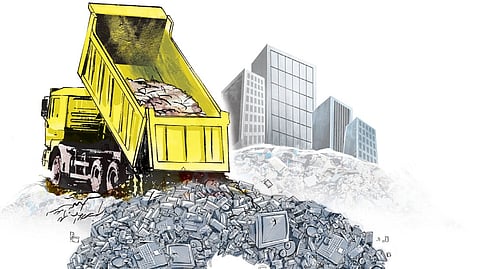

THIRUVANANTHAPURAM: Recent news reports of tonnes of electronic waste, allegedly from Kerala, dumped in Tamil Nadu’s Tenkasi district have exposed the glaring gaps in the state’s e-waste management system.
While Kerala has put in place a scientific collection and recycling mechanism through the local self-government department (LSGD) and the Clean Kerala Company Ltd (CKCL), officials admit that only a small fraction of e-waste generated in the state reaches authorised collection channels.
Most of it continues to be diverted to the informal sector, where valuable components are salvaged and the remaining low-value or hazardous waste is often dumped illegally to save on costs.
The LSGD had last year launched Eco Banks as designated collection centres for e-waste and other special non-biodegradable waste generated by households and institutions to reduce dependence on scrap dealers and ensure that discarded electronic items reach authorised recyclers through CKCL. However, the project has not garnered the expected public response.
According to CKCL, the state agency responsible for scientific management of non-biodegradable waste, 2,678 metric tonnes of non-hazardous e-waste were collected and scientifically processed between March 2014 and March 2025.
It handled around 422 metric tonnes of e-waste during 2025-26 and has already collected and disposed of 33 metric tonnes until June this fiscal.
CKCL MD G K Suresh Kumar said hazardous e-waste is handed over to KEIL (Kerala Enviro Infrastructure Ltd) for scientific treatment and disposal, while non-hazardous e-waste is sent to cement manufacturing units for co-processing and resource recovery.
However, the authorised system captures only a fraction of the state’s total e-waste, admit officials.
“The biggest challenge is the informal sector. They purchase discarded electronic items directly from households and commercial establishments, recover components with resale value and often dump the remaining low-value or hazardous waste as scientific disposal involves transportation and processing costs,” said a senior LSGD official.
“The Eco Bank project is yet to gain public acceptance. We tried bringing the informal sector, particularly scrap dealers, into the authorised system, but that too did not materialise,” the official said.
RUBBLE TROUBLE
Only small fraction of e-waste generated in Kerala reaches authorised collection channels like CKCL. A majority is instead diverted to informal sector where valuable components are salvaged and low-value or hazardous waste is dumped illegally. LSGD’s Eco Bank, launched to collect e-waste and other special non-biodegradable waste and ensure they reach authorised recyclers through Clean Kerala Company Ltd, has failed to gain traction.
2,678 tonnes
Non-hazardous e-waste handled by CKCL between 2014-15 and 2024-25
422 tonnes e-waste handled by CKCL during 2025-26
Hazardous e-waste is sent to KEIL
Non-hazardous e-waste is sent to cement manufacturing units
Wealth from waste?
33 tonnes collected till June of current fiscal
Efforts to integrate scrap dealers into the authorised system have not succeeded
Proper recycling helps recover valuable materials and prevents pollution
