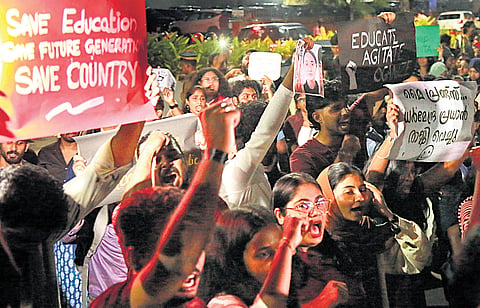

KOCHI: For decades, student politics in Kerala has largely unfolded under the banner of organised entities such as the Students’ Federation of India (SFI), the Kerala Students Union (KSU), the Muslim Students Federation (MSF) and the All India Students’ Federation. But the youth protests over alleged NEET examination irregularities have introduced a different model of mobilisation: one that is leaderless, digitally coordinated and consciously unaffiliated to political parties or student bodies.
From Malayali students travelling to Jantar Mantar in New Delhi to solidarity gatherings in Kochi, Thiruvanathapuram and other parts of Kerala, participants insist they are not representing any political party or even the Cockroach Janta Party (CJP). Instead, they describe themselves as independent youth united by a common cause.
For 26-year-old Muzammil S, a student and part-time graphic designer from Thiruvananthapuram who travelled to New Delhi to join the protest, the absence of a formal leadership is precisely what sets the movement apart. “Political organisations have their own structures, coordination and strategies before taking decisions. We are different. We are flexible, like water. We have coordination, but we don’t have leaders,” he said.
“If we waited for leaders, it would have taken time. We started first. Political organisations joined later,” he said, adding that technology has enabled young people from Thiruvananthapuram to Kasaragod to organise rapidly without conventional structures.
Saniya Benny, a journalism graduate from Kozhikode, said the decision to travel to Jantar Mantar was born out of a sense of responsibility. “When we saw what was happening, all of us wanted to be there. We connected through Instagram, formed a community and around 80 people travelled by train to Delhi. We are not part of CJP or any political party. We represent the youth of India. We felt it was our responsibility to stand there,” the 23-year-old said.
Similar sentiments have shaped the solidarity protests in the state. Steve Manjaly, who organised the first gathering at the Gandhi Peace Foundation in Kochi, said the objective was to support youngsters leading the movement rather than to direct them. “This is their future. They should decide how they want to fight. Our role is simply to support them,” he said.
Steve described the protests as fundamentally different from earlier demonstrations. “This is not one or two individuals. There is no leader. Many of us cannot travel to Delhi, so we organised in Kochi instead. Today’s youngsters are rewriting the methodology of dissent. They are doing something we haven’t seen before,” he said. “The previous generation still had some confidence that education would lead to employment. This generation doesn’t even have that assurance. Yet they are creating a movement,” he said.
Alex George Verghese, who participated in the protest in Kochi, said the protests should not be limited to street demonstrations. “For many students, this is the first time corruption has directly affected their future through something as significant as a medical entrance examination. We want to create safe spaces where students can speak about the problems they face. A single protest is not enough; these conversations have to continue,” Alex, who hails from Kottayam, said.
He said while the movement supports the nationwide protests, its long-term direction remains an open question.“We don’t know what the CJP roadmap is. Every movement needs to decide what comes next. But irrespective of that, students need spaces to organise and express themselves,” he said.
The emergence of the movement has not been viewed as a challenge by established student organisations. Admitting that the anger expressed by protesters reflects genuine dissatisfaction among the younger generation, SFI state president M Sivaprasad, however, argued that Kerala’s campus politics already provides organised platforms for student mobilisation.
“The dissatisfaction is genuine. It reflects an anti-government mood across the country. But Kerala is different because we already have strong student unions and vibrant campus politics. Elsewhere, students may have to look for alternative platforms. In Kerala, these already exist,” he said.
According to Sivaprasad, the SFI has actively participated in the protests without viewing the Gen Z movement as a threat. “We have been able to be part of the movement without weakening Kerala’s strong student union culture. That is Kerala’s uniqueness. We don’t see this as a challenge,” he said.
KSU state president Aloshious Xavier echoed the sentiment, saying student causes transcend organisational affiliations. “We don’t see this as a challenge or a threat. Political affiliations don’t colour our support. If the cause concerns students, we stand in solidarity with it,” he said. “The movement doesn’t yet have ideological clarity, which is why people across political backgrounds are supporting it,” Aloshious stressed.
Author Paul Zacharia urged caution against reading too much into a single movement. “This emerged from a particular examination issue. One incident alone cannot explain a larger political shift,” he said. At the same time, he argued that questioning authority is itself a political act. “There is a misconception that politics is created only by political parties. The moment young people begin asking questions, politics is being created. That is far healthier than simply functioning as foot soldiers of political parties,” he said.
Zacharia also questioned whether the resignation of a minister alone could resolve deeper structural issues. “Our political culture has taught us that a minister’s resignation solves everything. It doesn’t. The larger problem still remains,” he said.
Chief Minister V D Satheesan has welcomed the resignation of Union Education Minister Dharmendra Pradhan, describing it as an “inevitable” outcome of the nationwide student protests and a “historic victory” for the country’s youth. In a statement, Satheesan said Pradhan had no option but to step down and that his resignation came only after the Centre failed in its attempts to suppress protesting students through force.
He hailed the determination and fighting spirit of students, saying their sustained agitation had compelled the minister to resign. Describing the resignation as a victory for democratic protests, Satheesan said attempts to crush the agitation through intimidation and anti-democratic methods had failed. He urged Centre not to gamble with the future and lives of students.
Leader of Opposition Pinarayi Vijayan said, “The central government’s arrogance has finally been forced to yield before the determination of the country’s student community. The success of this movement is also a major setback for the Modi government’s authoritarian style of governance. The BJP-led government, which ignored the question paper leaks and the anguish of lakhs of students and responded to protests with authoritarian tendencies, has now witnessed the strength of democracy.”
Congress MP Priyanka Gandhi Vadra on Saturday welcomed the resignation of Dharmendra Pradhan as Union Education Minister, saying that the government had to bend before the youth and students of India. “The youth did not bend; the government had to bend. It is a victory for the youth and students of India. I was really and truly happy when I heard the news. I even got a bit emotional,” she told reporters in Wayanad following reports of Pradhan’s resignation. Calling it a significant moment for Indian democracy, Priyanka said the resignation reflected the power of peaceful public protest and the supremacy of the people’s will.
